
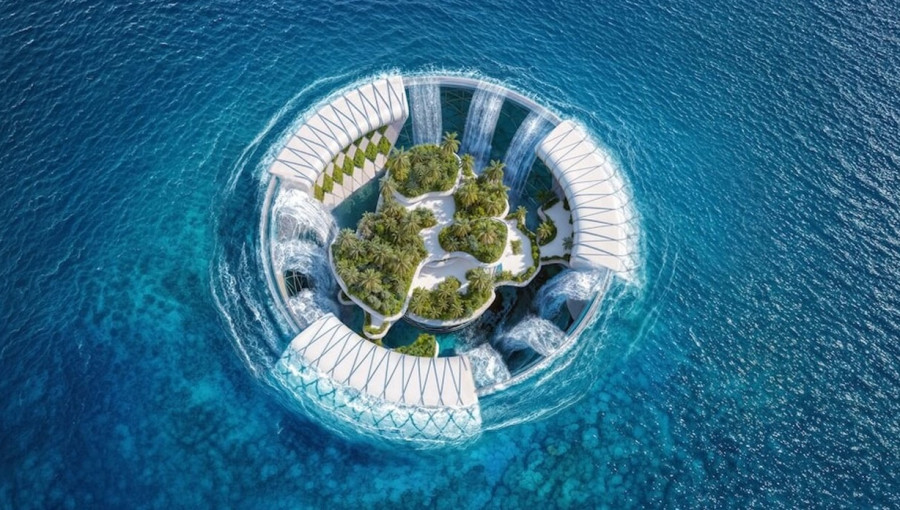
Designer Ahmad Eghtesad has unveiled a visionary concept titled the Baobab Waterfall, a floating infrastructure project designed to address Madagascar’s severe energy crisis and social challenges. Inspired by the resilient native baobab tree, this maritime structure utilizes deep-ocean water to generate significant renewable electricity. Beyond its primary role as a power plant, the facility incorporates greenhouses for agricultural production and serves as a rehabilitation center. The project, created for the Jacques Rougerie Foundation, aims to eventually transition from a social institution into a multipurpose resort, demonstrating how architectural design can simultaneously tackle energy, food security, and societal reform.
The Baobab Waterfall functions as a continuous deep-ocean system, channeling massive volumes of seawater to harness renewable energy through natural hydrological forces. By integrating industrial power generation with agricultural greenhouses, the design rejects the notion of singular-purpose infrastructure. This dual-layered approach ensures that the facility provides both clean energy and food cultivation, offering a sustainable model for regions struggling with economic and resource instability. The structure’s form, which is wide at the crown and deeply anchored, is intended to withstand the harsh conditions of the Indian Ocean while mirroring the life-sustaining properties of the baobab tree.
Social rehabilitation is a central pillar of the project’s mission. Conceived as a response to the overcrowding and poverty-driven issues within Madagascar’s correctional facilities, the structure is designed to provide a space for social repair. As the facility matures and local crime rates decrease, the complex is intended to evolve into a green energy hub and resort. This long-term strategy aims to replace institutional hardship with a legacy of prosperity. By blending human engineering with the raw power of the ocean, the concept challenges architects to consider how infrastructure can proactively foster societal well-being.