Solar Panel Prices Climb Amid Regulatory Changes in China

Solar panel prices have seen a nearly 5% increase as China's government tightens its regulatory measures on the photovoltaic industry. The Chinese Module Marker for TOPCon modules rose this week to $0.086/W, fueled by stronger market sentiment following a regulatory meeting aimed at curbing competition. New pricing regulations are speculated, including a potential minimum sale price. In Europe, TOPCon prices have stabilized, while interest in higher-efficiency HJT products is growing despite their premium costs. In the U.S., module prices have also risen, influenced by tariff adjustments and safe harbor regulations, as developers aim to secure advantageous deals before deadlines.
The Chinese Module Marker (CMM), OPIS’s benchmark for TOPCon modules ≥600W, rose 1.18% this week to $0.086/W Free-On-Board (FOB) China, with market indications between $0.084–0.093/W. Since the beginning of the second half of 2025, prices have recorded an increase of 4.88%. Forward curve indications tracked the spot market higher. Prices for Q4 2025 loadings increased to $0.086/W, while Q1 and Q2 2026 remained steady at $0.086/W. Q3 2026 loadings edged higher to $0.087/W. In the domestic market, OPIS assessed TOPCon prices at CNY 0.690 ($0.096)/W EXW China, up 0.73% week-on-week.
Sentiment improved following a Ministry of Industry and Information Technology (MIIT)–led meeting, the second in H2 2025 aimed at curbing disorderly competition. Compared to the July session, the August meeting was broader, addressing four key areas: stronger regulation, restrictions on below-cost competition, stricter quality enforcement, and enhanced industry self-discipline. Market speculation has centered on regulators potentially setting a minimum domestic sale price of CNY 0.75/W ($0.096/W FOB China with VAT). If implemented, this would mark a departure from the non-binding cost guidance issued by the China Photovoltaic Industry Association (CPIA), introducing enforceable legal measures. However, many participants remain cautious, questioning the sustainability of such levels given current inventory conditions.
CPIA has also called on local governments to enforce the Price Law, establish minimum bidding prices, and reduce the weight of price factors in tenders. The association emphasized rational production aligned to supply-demand dynamics, as well as quality assurance and intellectual property protection. Recent tenders suggest improving sentiment. Huadian Group awarded a 20 GW module procurement for 2025–2026, with TOPCon bids averaging CNY 0.710/W, while China Resources Power’s 3 GW tender posted averages above CNY 0.70/W. These outcomes indicate market stabilization around higher price ranges.
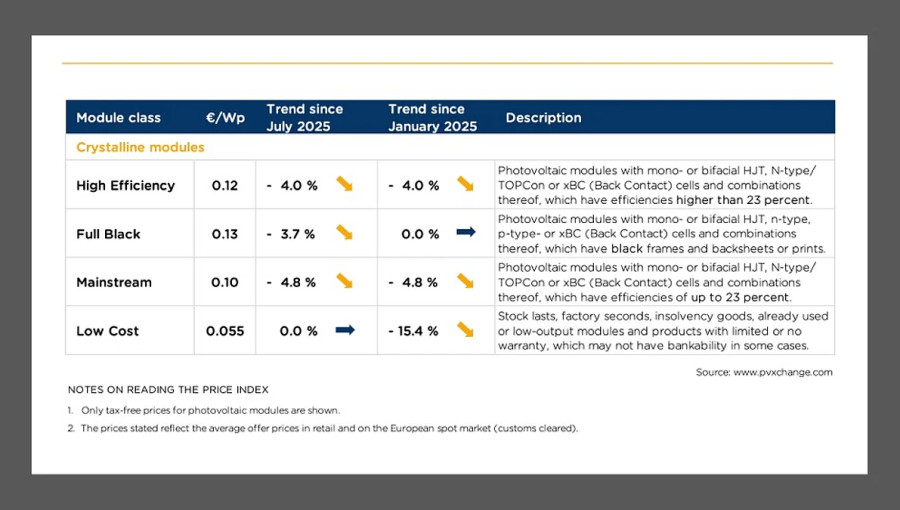
In Europe, TOPCon module prices remained steady through the holiday season, with OPIS assessing DDP Europe prices at €0.092 ($0.11)/W for modules ≥600W. However, higher-efficiency HJT products are drawing growing interest despite their price premium, with reported prices at €0.095/W for ≥600W modules and €0.105/W for ≤450W modules. Domestic HJT manufacturing momentum is building. Italy-based Enel’s 3Sun already operates facilities, while Spain’s MCPV plans a 2.5 GW HJT plant. Bee Solar and China’s Huasun Energy signed a Letter of Intent to develop integrated HJT manufacturing in Italy, with operations targeted for 2026.
At the policy level, some governments are tightening support. France has cut tender volumes, while Sweden intends to reduce tax credits, creating headwinds. Nonetheless, new financing and projects continue: German developer Energiekontor launched a €15 million bond to fund solar and wind projects across Europe, while utility RWE secured 37 MW in