South Korean Researchers Develop Model To Predict Artistic BIPV Performance
The new framework assesses how image-based color variations in building-integrated solar modules affect power output and the risk of hot spots.
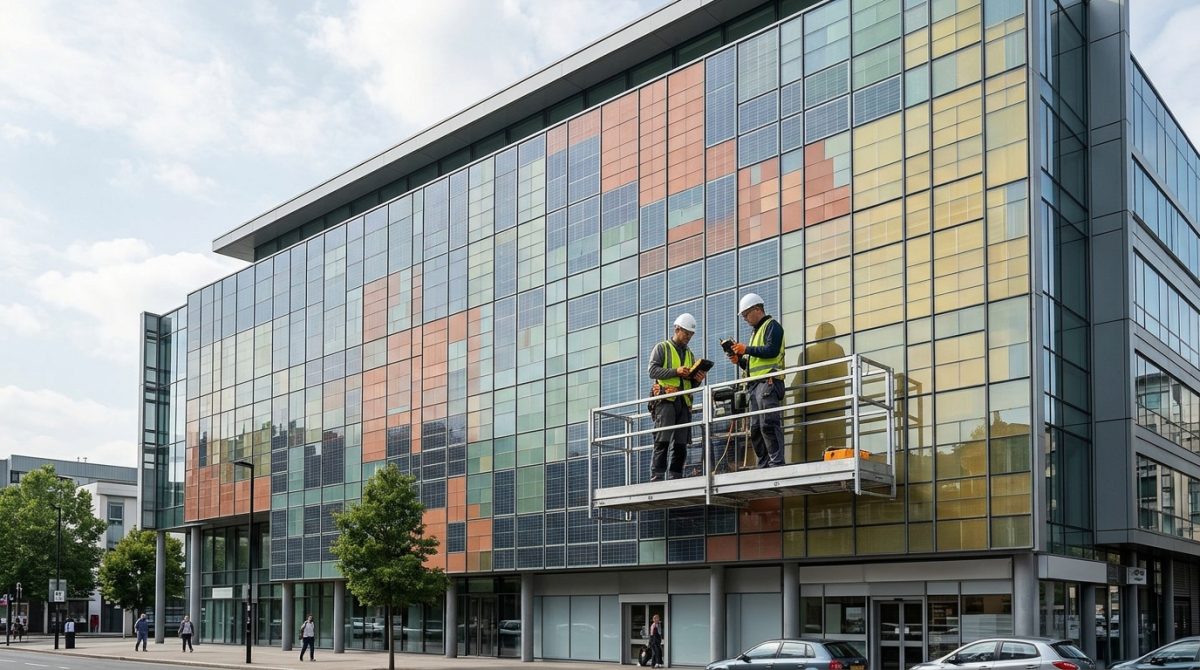
A research team from South Korea has created a model to evaluate the electrical performance and reliability of colored building-integrated photovoltaic (c-BIPV) systems that display artistic images. By analyzing 50 famous artworks, the researchers established a link between the visual characteristics of an image and the power output of a solar array, identifying potential risks such as hot spots caused by spatial color mismatches.
The study, conducted by researchers from Seoul National University of Science and Technology and Gachon University, converted artworks into 36 × 36-pixel mosaics, where each of the 1,296 pixels represented a series-connected solar cell. The team calculated the photocurrent for each pixel based on the selective-reflection spectrum required to reproduce its color. Using equivalent-circuit simulations, they modeled the arrays to determine how different bypass-diode configurations influenced power generation and cell reverse bias.
The findings revealed that the spatial distribution of brightness is more critical to performance than the overall colorfulness of an image. For instance, an array displaying Vincent van Gogh’s Café Terrace at Night achieved 91.7% of the power output of a black reference array, whereas Girl with a Pearl Earring reached 74.3%. The researchers noted that even a few extremely bright pixels can significantly limit the output of a series-connected array.
The team also identified a trade-off regarding bypass diodes, which can improve power output but may increase the number of cells operating under reverse bias, thereby raising hot-spot risks. For the Girl with a Pearl Earring design, the researchers found that selectively darkening specific pixels could improve power output without the need for additional bypass diodes, effectively avoiding reverse-bias conditions.
Based on these results, the team developed a screening framework that classifies images using two parameters: the brightest pixel and overall brightness variation. This approach allows for the assessment of an image's electrical suitability without requiring full circuit-level simulations. Future research will focus on incorporating measured reflectance spectra, expanding the image database, and creating an AI-assisted tool to suggest modifications that optimize power output while maintaining the visual integrity of the artwork.