
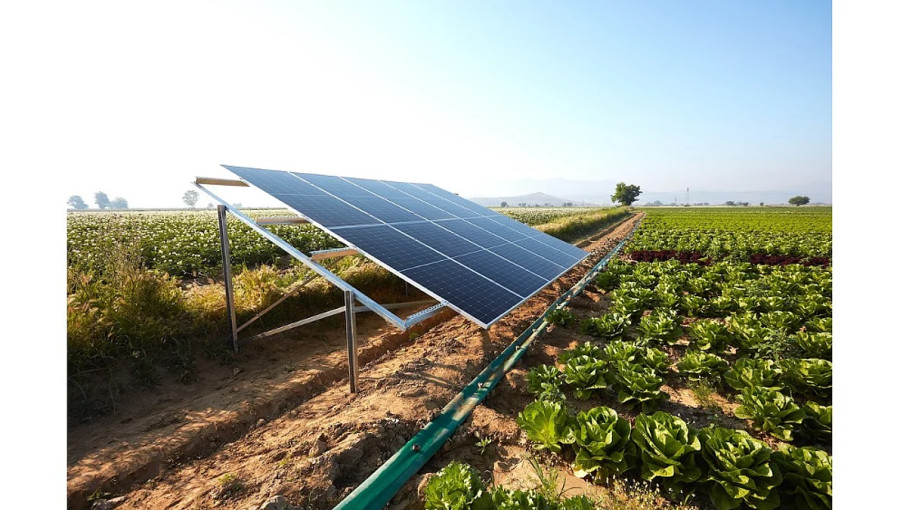
The US Department of Agriculture (USDA) has announced that it will discontinue funding for solar panels on prime farmland and prohibit the use of foreign-made solar panels in its projects. This decision aims to safeguard farmland availability, which has reportedly become more costly and limited due to subsidized solar farms. Moving forward, funding under the Rural Energy for America Program (REAP) will only support appropriately sized systems for on-site energy consumption, with restrictions on larger ground-mounted systems. In addition, solar and wind projects will no longer qualify for the USDA’s Business and Industry Guaranteed Loan Program.
The USDA’s decision reflects concerns about the displacement of farmland by solar projects, particularly in rural regions with a strong agricultural legacy. Officials contend that taxpayer funds are no longer to be utilized for financing solar developments that compromise valuable agricultural land. The agency also asserted that solar panels produced by foreign adversaries will be banned from USDA-backed projects. This sentiment was echoed by Georgia Representative Austin Scott, who criticized solar projects as detrimental to land resources.
Under the REAP program, the USDA offers guaranteed loans, covering up to 75% of project costs, and grants that can cover up to 50% of costs for renewable energy systems and energy efficiency improvements. Historically, the USDA invested more than $2 billion in REAP initiatives from 2018 to 2022, including an infusion of $145 million due to the Inflation Reduction Act (IRA). Alongside the recent policy changes, the USDA did not clarify whether these new provisions affect previously approved loans or grants.
Additionally, the USDA’s recent measures build upon previous actions taken to modify or repeal green energy tax credits under the One Big Beautiful Bill Act (OBBBA). The Biden administration has also announced stricter evaluations for wind and solar projects on public land, suggesting a broader rethinking of the government’s approach to renewable energy funding. As these regulatory shifts unfold, TaiyangNews plans to discuss the implications for the US solar market at the upcoming RE+ 2025 event in Las Vegas, which will engage industry leaders on the future of solar and storage manufacturing in the current regulatory landscape.
https://taiyangnews.info/markets/us-government-stops-solar-wind-funding-on-farmland