
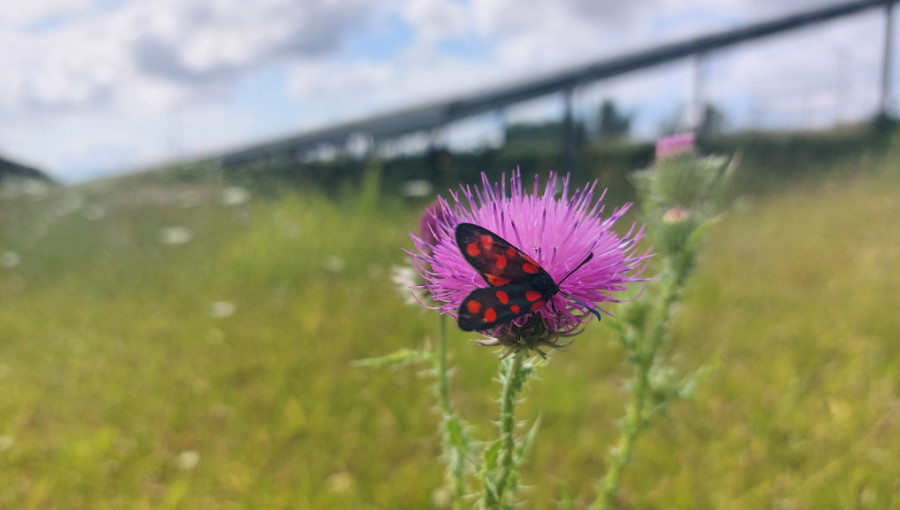
A new study conducted by Tim and Rolf Peschel reveals that farmland converted into solar parks significantly enhances biodiversity, contingent on local conditions. The research examined 30 solar parks in Germany and one in Denmark, evaluating eight species groups from April to September 2024. The study highlighted the recovery of biodiversity on former arable lands, showing that solar parks serve as biodiversity islands, allowing various species to thrive, including rare plant and animal species that are no longer found in surrounding agricultural areas.
The study found that biodiversity increases significantly on farmland converted to solar parks, though the pace and extent of improvement depend on local conditions. When solar panels are installed on land formerly used for intensive agriculture, biodiversity rebounds quickly. This is the finding of a study by conservation expert Tim Peschel and biologist Rolf Peschel, conducted on behalf of the German Association of Energy Market Innovators (Bundesverband Neue Energiewirtschaft, BNE). To this end, the two authors, together with several specialist consultancies, examined biodiversity development in 30 solar parks across Germany and one open-field installation in Denmark. From April to September 2024, they surveyed eight species groups, including birds, amphibians, butterflies, bats, and plants. Unlike previous studies, however, this one did not focus on land conversion areas, but specifically on former arable land. The aim was to understand how quickly these sites recover in terms of species diversity and how this regeneration influences biodiversity across the wider cultural landscape. “After all, a great deal of biodiversity has been lost in agricultural areas in recent decades – in some cases to a dramatic extent,” says Tim Peschel.
He and Rolf Peschel demonstrated that these biodiversity losses can be offset when land is removed from intensive agricultural use and left largely undisturbed beneath solar installations. “In contrast to agricultural landscapes, solar parks have a variety of structures such as paths, wet areas, and shady pools under the modules,” explains Tim Peschel. “So even when everything is dry all around, we can still find flowering plants in shady areas. These provide the basis for insects to settle. These insects, in turn, are the food source for birds, bats, and amphibians. In this way, the areas can develop biodiversity.” Solar parks thus become islands of biodiversity within intensively used agricultural regions.
During their research, the authors identified 385 plant species within the solar park sites that were no longer present in the surrounding agricultural land. Among them were very rare species that have now begun to reproduce again. Rolf Peschel notes that the number and type of plant species vary significantly depending on the region. “We examined one of the solar parks several times over several years,” he explains. “That site had twice as many plant species as the next most diverse park. The more often we survey the areas, the more species we find. This shows that the development of biodiversity is still in full swing and far from complete. We know that there are more and more species.” The same applies to the animal species observed in the study. Among others, the researchers documented 13 of the 79 dragonfly species native to Germany. One of these is currently classified as endangered, yet in one of the solar parks, it is now establishing a strong population. This particular site can therefore be considered a source habitat, from which the species may begin to repopulate other previously uninhabited areas.
In addition, the researchers documented 37 percent of Germany’s native grasshopper species and 17 percent of its butterfly species within the solar parks. The findings on amphibians were also notable: one-third of the country’s native species were observed. Numerous reptiles, including various lizard species, were also present. What makes these results particularly striking is that the solar parks often exist in isolation – disconnected from larger surrounding habitats. The authors of the study also recorded 32 different bird species in the solar parks. Among them were endangered species such as the skylark, which
https://www.pveurope.eu/agriculture/study-links-solar-parks-richer-rural-ecosystems