
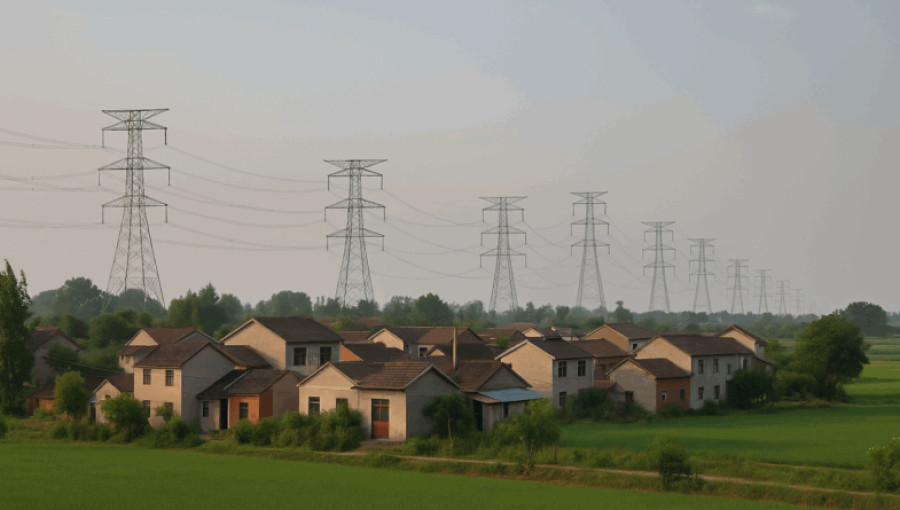
The recent article by Keith Bradsher in The New York Times explores China’s expansive ultra-high-voltage transmission grid, describing it as an engineering marvel. However, it raises concerns about the sensational language used, which can distort factual understanding and fuel myths surrounding electromagnetic fields and safety risks. While the infrastructure itself is designed with safety in mind and achieves notable efficiency in electricity transmission, anecdotal accounts of villagers feeling numb near power lines or witnessing sparks from wet umbrellas contribute to a narrative of fear rather than fact. The piece emphasizes the need for accurate communication and understanding of technology, particularly in the face of critical energy transitions worldwide.
Bradsher’s article paints a vivid picture of China’s impressive grid, showcasing high-voltage corridors that facilitate the movement of electricity from various energy sources across vast distances. China has developed direct current transmission lines ranked at various voltages, peaking at 1,100 kV, which form the backbone of its interconnected national network. The Changji–Guquan link, for instance, can transmit up to 12,000 MW over 3,300 km, and this efficiency is primarily due to the reduction of current, which in turn minimizes resistive losses.
Despite this engineering success, the portrayal of individuals experiencing physical discomfort—such as numbness or witnessing sparks—steers the narrative away from an objective understanding of high-voltage transmission engineering. Engineers have long measured conditions under HVDC lines, finding that while electric fields can elicit mild reactions, they are not harmful and do not cause neurological effects. Such electrical fields are similar to harmless static electricity experienced during a summer storm.
This concern is echoed by research showing how anticipatory fears can take hold within communities, leading to reported symptoms tied to a phenomenon known as the nocebo effect, whereby expectations create discomfort. The same dynamics may be present with the emerging public narrative about China’s advanced high-voltage transmission systems, especially as they are often shrouded in technical complexity and perceived secrecy.
In contrast to the media landscape in the West, which can sensationalize fears about technology, China’s coverage tends to avoid such narratives. However, misleading portrayals from influential articles could influence public perceptions elsewhere, potentially hindering important energy infrastructure developments. The effective transmission of clean energy is crucial in curbing fossil fuel dependence and facilitating the shift towards renewable resources.
Highlighting the achievements of ultra-high-voltage transmission systems is also essential for fostering public trust and understanding. Clear communication based on scientific data is vital to counteract misconceptions associated with these technologies, as ungrounded fears can obstruct progress in energy transitions. Ultimately, celebrating the technological advancements in power transmission should focus on their role in the broader efforts toward decarbonization, rather than sensationalized fears surrounding electrical phenomena.