
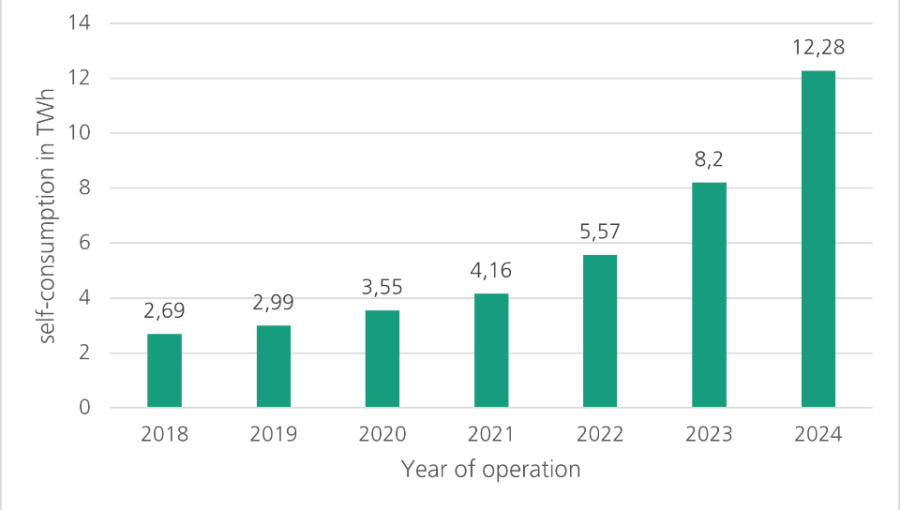
A new report from Germany’s Fraunhofer Institute for Solar Energy Systems (ISE) reveals a dramatic surge in the self-consumption of solar power among households and businesses. Driven by soaring electricity prices and the widespread adoption of battery storage, the amount of self-generated solar electricity used on-site has more than tripled since 2020. This trend, which now accounts for 17% of all solar electricity generation, marks a significant shift in Germany’s energy landscape, making on-site consumption more economically attractive than selling power back to the grid.
According to data from Fraunhofer ISE, the practice of using self-generated solar power saw modest growth between 2012 and 2020, rising from 0.25 TWh to 3.55 TWh. However, this trend has accelerated significantly since 2022, reaching 8.2 TWh in 2023 and a projected 12.28 TWh for 2024. Tobias Reuther, a data expert at the institute, noted the importance of this shift, stating that with nearly 60 TWh being fed into the grid, self-consumption’s share has climbed to 17% of total solar generation, a notable increase from 13% just a year prior.
This change in consumer behavior is primarily an economic one. Researchers at Fraunhofer explained that in previous years, generous feed-in tariff rates made it more profitable for solar panel owners to sell their electricity to the grid than to use it themselves. As electricity prices have climbed, this dynamic has completely reversed, creating a strong financial incentive for Germans to maximize their on-site power usage.
The trend is further amplified by the increasing integration of battery storage systems with solar PV installations. Data shows that for systems between 7 kWp and 20 kWp, the rate of co-installation with batteries is expected to jump from 51% in 2020 to 86% by 2025. Christoph Kost, head of Energy System Analysis at Fraunhofer ISE, anticipates this growth will continue, highlighting the dual benefits. “It is worthwhile for households, especially if they also use the electricity to operate a heat pump or charge their electric car, but it is also beneficial for the stability of the power grid,” he said, noting that locally consumed power reduces grid strain.
Recent government policy is set to reinforce this movement. Earlier this year, the German parliament passed “solar peak” legislation designed to encourage smarter energy management. The law will eliminate compensation for feeding power into the grid during periods of negative pricing, which occur when solar generation far exceeds demand. This measure creates a clear incentive for solar system owners to either use their generated power immediately or store it for later, rather than exporting it during times of surplus.