
The United States solar sector experienced a major upswing in the third quarter of 2025, installing 11.7 gigawatts of new capacity, making it one of the industry’s most productive quarters ever recorded. This performance brought total installations for the first nine months of the year to over 30 gigawatts. The growth was primarily fueled by large-scale projects, even as the industry grapples with significant political and permitting obstacles. In a parallel development, domestic manufacturing capabilities also expanded, highlighted by the milestone of the US now having the ability to produce the entire solar PV supply chain domestically.
This third-quarter installation figure represents a substantial rebound from the 7.5 gigawatts added in the second quarter of 2025, a slowdown that followed the passage of the One Big, Beautiful Bill Act (OBBBA). Solar power accounted for 58% of all new electricity-generating capacity brought online in the US during the quarter. However, persistent roadblocks threaten future growth. According to the Solar Energy Industries Association (SEIA), federal actions, including a July memo from the Department of the Interior, have created “significant business uncertainty” for utility-scale solar and energy storage developments.
Due to this lack of clarity on permitting timelines, long-term deployment forecasts through 2030 remain suppressed, projecting 55 gigawatts less capacity by the end of the decade than initially anticipated. “Remarkable growth in Texas, Indiana, Utah and other states… shows just how decisively the market is moving toward solar,” said Abigail Ross Hopper, president and CEO at SEIA. She cautioned, however, that unless the administration changes its course, “the future of clean, affordable and reliable solar and storage will be frozen by uncertainty.” SEIA has warned that as much as 73 gigawatts of planned solar projects are currently at risk.
The utility-scale segment was the primary driver of the third-quarter surge, contributing 9.7 gigawatts of new solar PV. This was a 68% increase from the previous quarter and a 26% rise compared to the same period a year ago. California, Texas, and Utah each added over one gigawatt of new capacity. The commercial solar sector grew 9% year-over-year with 554 megawatts installed, though it saw a 12% quarterly decline. Residential solar installations dipped slightly by 4% to 1,088 megawatts, a trend attributed to equipment constraints. Meanwhile, the community solar market added 267 megawatts, down 21% from the previous year but up 12% from the prior quarter.
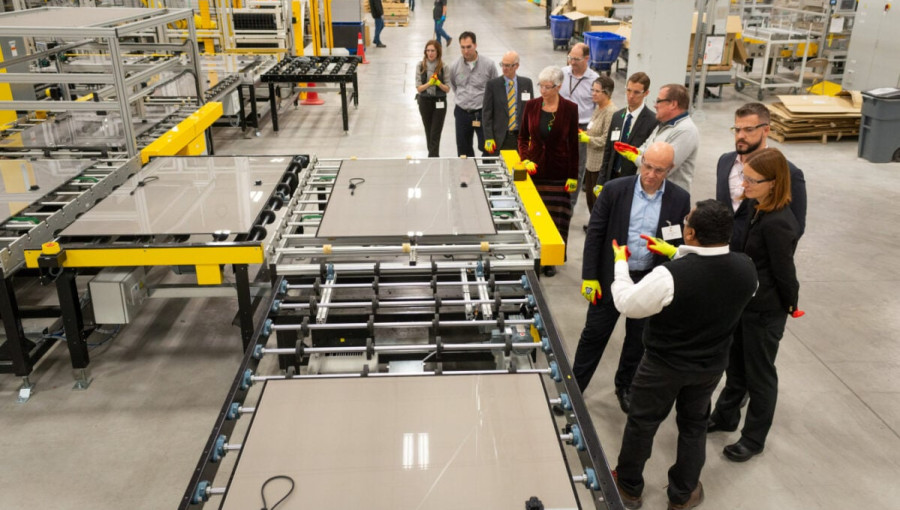
On the manufacturing front, the US added 4.7 gigawatts of new solar module production capacity in the third quarter, bringing the nation’s annual nameplate capacity to 60.1 gigawatts. This included First Solar’s new 3.5-gigawatt facility in Louisiana. The most significant development, however, was the commencement of wafer production by Corning. This achievement marks the first time the United States has possessed domestic manufacturing capabilities for the entire solar PV supply chain, from raw polysilicon to finished solar modules.