
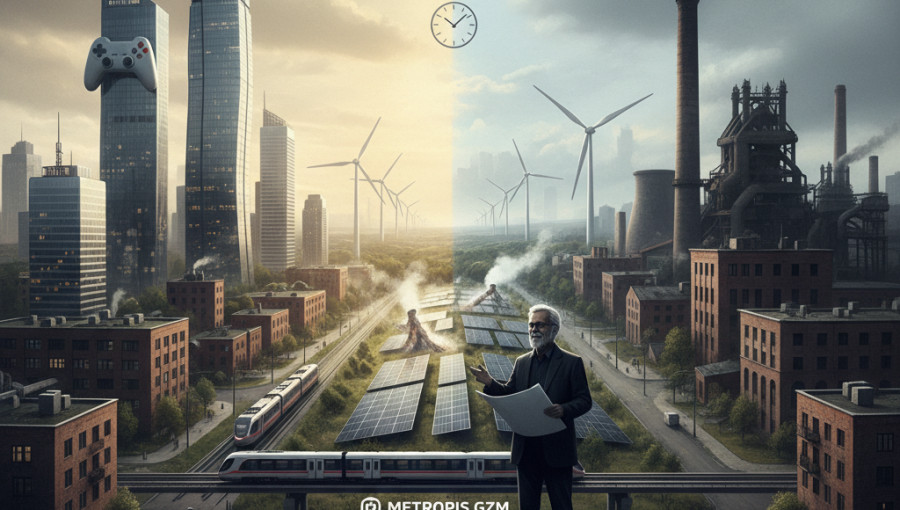
Poland’s Silesia region, the largest coal-mining hub in the European Union, is navigating a complex “just transition” aimed at phasing out its centuries-old industry by 2049. While the shift is fueled by a surge in manufacturing and technology, the economic benefits remain unevenly distributed between flourishing cities like Katowice and struggling areas like Bytom. By adopting a gradual phase-out strategy, regional leaders hope to avoid the social collapse seen in other historical mining hubs, providing workers with the time and financial resources necessary to adapt to a post-coal economy.
In the city of Bytom, the weight of industrial history is palpable. Conveyor belts still ferry shards of black rock across the street from local shops, while coking plants release thick clouds of steam into a perpetually gray sky. For generations of Silesians, coal has been more than an energy source; it has been a way of life that survived shifts in borders, political regimes, and economic systems. Today, however, the region is focused on managing the decline of this industry with minimal social upheaval.
Adam Drobniak, an economist at the University of Economics in Katowice, has spent years brokering a transition plan that prioritizes the livelihoods of thousands of workers. Unlike the rapid and often devastating industrial collapses seen in the United Kingdom during the 1980s, Poland’s strategy focuses on “winning by time.” This approach allows the economy to naturally develop new sectors—such as automobile manufacturing, electronics, and machinery—to absorb the labor force as mines gradually close.
The financial framework for this transition is robust. Under an agreement reached with labor unions and the government, miners can access free retraining for new careers while remaining employed. Those who choose to leave the industry entirely are eligible for a one-time severance payment of 170,000 Polish zloty. Furthermore, workers within four years of retirement can exit early while receiving 80% of their annual salary. This safety net is intended to prevent the mass unemployment that plagued the region during post-Soviet reforms in the 1990s.
While the strategy focuses on human capital, the landscape is also physically changing. Wind turbines now dot the horizon, and *solar panels* are becoming a common sight on older stone rooftops. Poland is also aggressively pursuing nuclear energy and exploring geothermal heat to replace coal in district heating systems, aiming to reduce *CO2 emission* levels that remain among the highest in the EU.
However, the transition has created a stark divide within Silesia. Katowice has transformed into a modern metropolis, where former mine sites have been repurposed into video game development hubs and upscale cultural districts. In contrast, Bytom has lost nearly a quarter of its population since the early 2000s, struggling with deep-seated poverty and high unemployment. To bridge this gap, researchers have proposed the creation of “Metropolis GZM,” a plan to merge central Silesia’s patchwork of cities into a single, interconnected urban structure of 2.5 million people.
By uniting these areas through shared infrastructure and railways, officials hope to create a competitive alternative to Warsaw or Krakow. The goal is to retain the younger generation and ensure that the cultural identity of the mining heartland evolves rather than disappears. For the people of Silesia, the slow phase-out is not a delay of the inevitable, but a necessary measure to ensure that the birth of a new economy does not come at the cost of the community’s survival.