
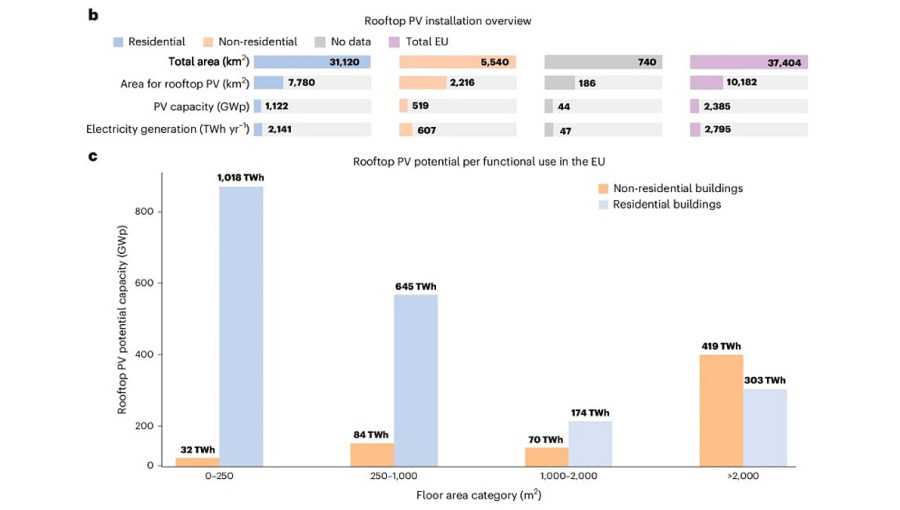
A new study by the European Commission’s Joint Research Centre reveals that the European Union possesses a massive rooftop solar potential of 2.3 TW. This capacity could generate approximately 2,750 TWh of electricity annually, potentially meeting 40% of the bloc’s projected power demands by 2050. While residential buildings account for the majority of this potential, currently only 10% of EU rooftops utilize solar PV. Researchers urge policymakers to prioritize rooftop installations to meet decarbonization targets and enhance energy independence across member states through streamlined regulations and financial incentives.
The research, published in the journal Nature Energy, utilized the European Digital Building Stock Model (DBSM) to analyze 271 million buildings across the EU. By applying a standard solar module efficiency of 22% and assuming south-facing orientations, the study provides a conservative yet realistic baseline for the continent’s energy transition. Of the total 2.3 TW potential, residential structures represent 1,822 GW, while non-residential buildings contribute 519 GW. This vast infrastructure could fundamentally reshape the European energy landscape, provided technical and regulatory barriers are addressed.
Geographically, the potential is distributed widely, with almost every EU nation capable of exceeding 40 GW in technical capacity. Large economies like France and Germany lead in absolute terms, with the potential to generate 432 TWh and 394 TWh respectively—enough to cover over 80% of their current electricity needs. Smaller or sunnier nations such as Greece, Romania, and Hungary show even more dramatic possibilities, with rooftop solar potential significantly exceeding their current national electricity consumption.
The study highlights that building size and type are critical factors in deployment. Large-scale structures exceeding 2,000 square meters represent 25% of the total technical capacity. However, the most significant residential opportunity lies in small homes with floor areas between 100 and 250 square meters. These properties alone could contribute 900 GW of capacity. Conversely, mid-sized apartment complexes face the steepest hurdles due to complex multi-ownership structures and restrictive local building codes, identifying a key area where policy intervention is required.
Despite these opportunities, the EU currently utilizes only a fraction of its rooftop space. Existing residential and non-residential rooftop systems total approximately 215 GW, representing about 61% of the Union’s current 339 GW total solar capacity. To bridge this gap, the Energy Performance of Buildings Directive (EPBD) will mandate solar installations on large public and commercial buildings starting in 2027, followed by all new residential homes in 2030.
Beyond clean energy generation, the widespread adoption of rooftop solar offers secondary benefits such as reduced CO2 emission levels, lower energy bills for consumers, and increased property values. Researchers emphasize that because 95% of today’s buildings will still be in use by 2050, integrating solar panel installations into the renovation cycle is essential for the EU to reach its climate neutrality goals. These upgrades would allow more buildings to become energy self-sufficient, significantly reducing the overall pressure on the continental power grid.