
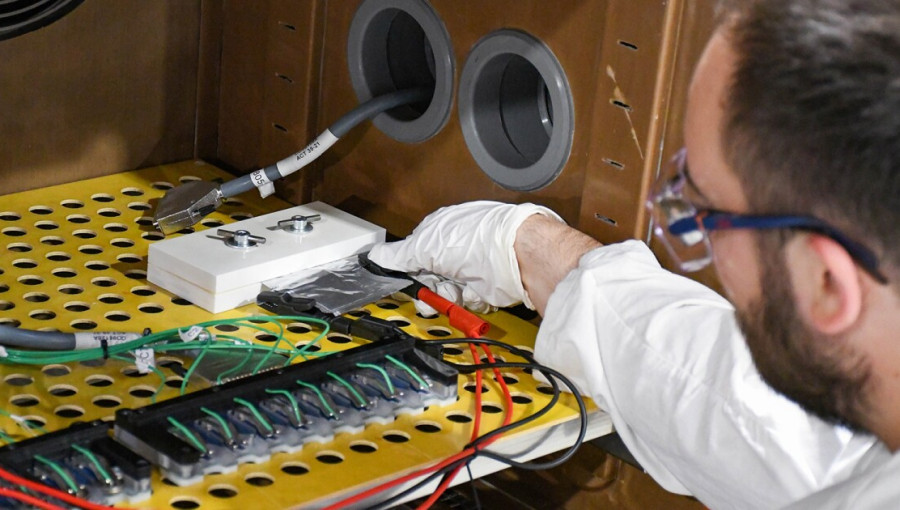
Researchers at Germany’s Fraunhofer Institute for Ceramic Technologies and Systems (IKTS) have pioneered a sustainable sodium-ion battery utilizing lignin, a natural wood polymer, as a primary electrode material. By converting this paper industry byproduct into hard carbon, the team has created a cost-effective and environmentally friendly alternative to traditional lithium-ion technology. This innovation reduces reliance on critical metals like cobalt and nickel while lowering CO2 emission levels. Designed for stationary storage and low-speed electric vehicles, these wood-based batteries offer a localized, recyclable solution for the future of energy storage.
Lignin serves as the structural “glue” in trees, providing strength to wood fibers. While it is abundant, the paper industry often treats it as a waste product, typically incinerating it for energy. Scientists at Fraunhofer IKTS have successfully transformed this biomass into high-performance hard carbon through high-temperature processing. This carbon is then utilized to manufacture the battery’s negative electrode, or anode, demonstrating that renewable organic materials can effectively replace finite mined minerals in modern energy systems.
A primary advantage of this technology is the security and sustainability of the supply chain. Unlike lithium, cobalt, and nickel, which are expensive and involve complex global logistics, lignin can be sourced locally in many regions. For this specific research, the material was harvested from the Thuringian Forest in central Germany, located near the research facility. Lukas Medenbach, a research scientist at Fraunhofer IKTS, noted that the project focuses on processing high-quality local lignin to eliminate critical metals from the battery value chain while also working to minimize fluorine content in the electrodes and electrolytes.
The battery’s positive electrode also follows an eco-friendly design, utilizing non-toxic, iron-based materials known as Prussian Blue analogs. These materials, derived from a pigment historically used in dyes, have been modified to store sodium ions efficiently. This combination of wood-derived carbon and iron-based cathodes makes the battery significantly safer and easier to recycle than conventional lithium-based units. Furthermore, by repurposing lignin rather than burning it, the process contributes to a net reduction in CO2 emission.
Initial laboratory testing has yielded positive results, with the lignin-based hard carbon showing excellent cycle stability. The cells have maintained their performance through 100 charging and discharging cycles without significant degradation, and the team aims to reach 200 cycles for a 1-Ah full cell by the end of the project. While these batteries are not intended for high-power applications, they are well-suited for stationary energy storage and small electric vehicles, such as forklifts or microcars with speed limits of 45 kilometers per hour.