
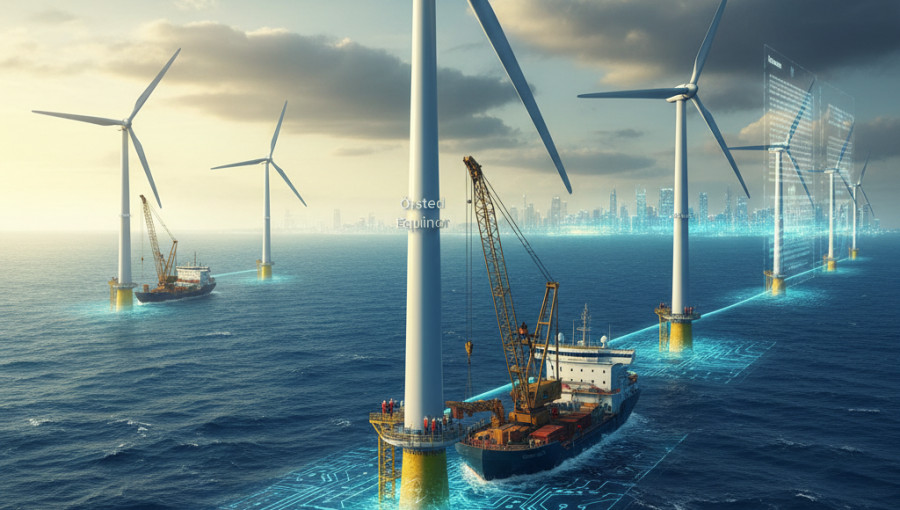
Major offshore wind developers in the United States have resumed construction on three multi-billion dollar projects following a federal court ruling that lifted a month-long suspension. Developers Ørsted, Equinor, and Dominion Energy were granted permission to continue work after a judge challenged the Trump administration’s “national security” justification for halting the projects. The restart is vital for regional grid stability and meeting surging energy demands, particularly as several projects near completion and face tight logistical windows for specialized installation equipment.
Federal judges recently cleared the way for offshore wind activity to resume along the U.S. East Coast, ending a period of uncertainty that began with a Department of Interior order on December 22. The administration’s attempt to halt the projects cited vague national security concerns, a rationale that failed to hold up under judicial scrutiny. For the companies involved, the delay resulted in significant financial losses, with some projects facing daily costs in the millions.
Dominion Energy has already mobilized to continue its $11.2 billion Coastal Virginia Offshore Wind project. Following the court’s decision, the company began transporting turbine components to its site near Virginia Beach. With all 176 foundations already installed, the utility aims to begin power generation in the first quarter of this year. Once fully operational, the site will contribute 2.6 gigawatts to the grid, a capacity that regional operator PJM Interconnection describes as essential for supporting the massive growth of AI data centers.
Off the coast of Rhode Island, Ørsted has restarted work on the Revolution Wind farm. The project was nearly 90% complete when the stop-work order was issued. Most of the 65 planned turbines, along with necessary subsea cabling and offshore substations, are already in position. This marks the second time Ørsted has successfully challenged a federal suspension in court, with judges previously noting a lack of factual evidence to support the administration’s interference.
Equinor’s Empire Wind project, located off Long Island, also received a favorable ruling just in time to meet critical logistical deadlines. The developer had warned that further delays would jeopardize the use of a specialized heavy-lift vessel currently on-site. Because the vessel is only available until February, the legal victory allows Equinor to proceed with installing an offshore substation, avoiding a potential year-long delay that could have led to the project’s cancellation.
While three projects move forward, two others—Vineyard Wind and Sunrise Wind—remain on hold pending further legal action. Industry advocates emphasize that these offshore developments are crucial for stabilizing electricity prices, which have risen due to fossil gas volatility. Data from existing operations suggests that offshore wind can significantly lower wholesale market costs during peak demand, potentially saving ratepayers millions of dollars during extreme weather events.