
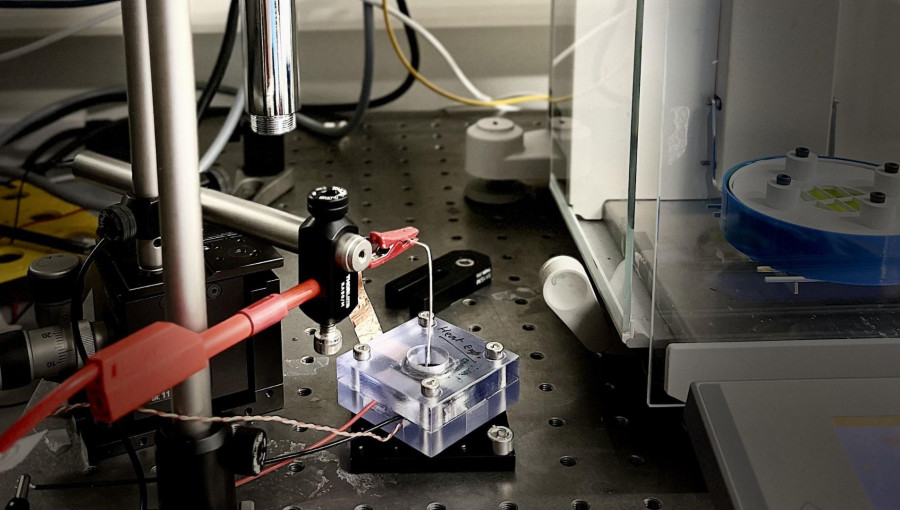
Researchers at the Swiss Federal Institute of Technology Lausanne (EPFL) have developed a groundbreaking nanodevice capable of generating electricity through the evaporation of saltwater. By utilizing light and heat to simultaneously control the movement of ions and electrons, the team achieved a fivefold increase in energy output compared to previous models. This hydrovoltaic technology features a durable trilayer design that resists degradation from salt, offering a promising solution for powering battery-free environmental sensors and wearable electronics using only natural resources like sunlight and water.
The innovation, led by the Laboratory of Nanoscience for Energy Technology (LNET), advances the emerging field of hydrovoltaic technology. Unlike traditional hydroelectric systems that use moving water to drive mechanical turbines, hydrovoltaic devices generate electricity through the interaction between water and functional materials at the molecular level. This process typically relies on evaporation or droplet flow to create a continuous electrical current.
The LNET team originally reported a nanoscale device in 2024 that utilized silicon nanopillars to facilitate fluid evaporation through narrow channels. Their latest iteration significantly improves upon this design by harnessing both light and heat to manipulate the internal physics of the device. While heat has long been known to accelerate evaporation and electricity generation in these systems, the researchers discovered that light also plays a critical role in exciting electrons within the silicon semiconductor.
The device features a sophisticated trilayer architecture specifically designed for evaporation, ion transport, and electrical charge collection. As saltwater moves through the evaporation layer, the heat-driven process causes ions to shift, creating a separation of positive and negative charges at the solid-liquid interface. This separation generates an electric field that drives a current through the circuit. According to Associate Professor Giulia Tagliabue, the combination of solar light and heat enhances the surface charge of the device, boosting energy production by 500%.
Performance metrics for the new nanodevice are impressive, reaching a voltage of 1 V and a power density of 0.25 W/m2. To ensure long-term stability, the researchers addressed a common pitfall of saltwater energy systems: material corrosion. By applying a specialized oxide coating to the silicon nanopillars, the team successfully protected the device from chemical degradation caused by salt, maintaining consistent performance over time.
This advancement opens new possibilities for sustainable, self-powering technology. The researchers envision a future where these devices provide a reliable energy source for environmental sensors and wearable tech without the need for traditional batteries. By refining the nanopillar structures and salt concentrations, the team believes they can further optimize the output of this natural energy-harvesting process. The full findings of the study have been published in the journal Nature Communications.