
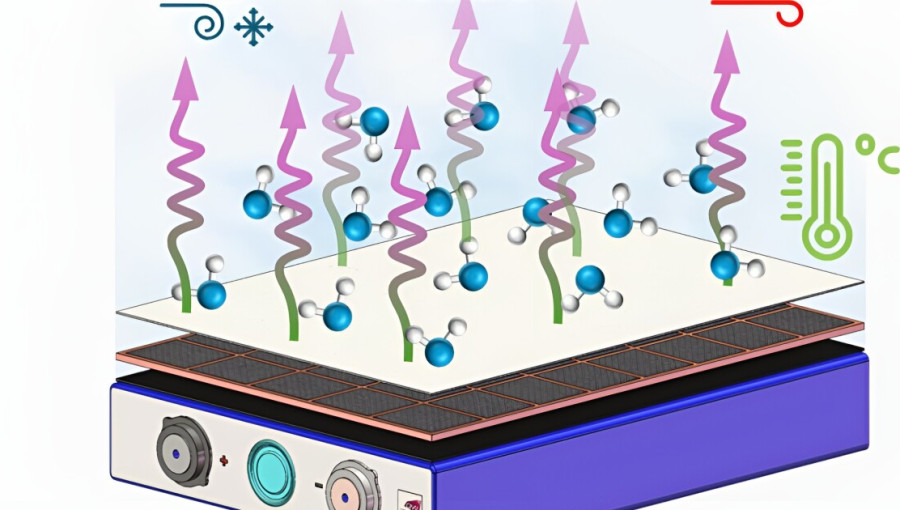
Researchers from the City University of Hong Kong have developed a revolutionary thermal management system for lithium-ion batteries inspired by the biological cooling mechanism of mammalian skin. This “skin-like” membrane utilizes a specialized nanocomposite material to absorb moisture from the atmosphere and evaporate it when temperatures rise, effectively allowing the battery to “sweat.” By providing a passive, energy-free cooling solution, this technology significantly extends battery lifespan and enhances safety by preventing thermal runaway. It offers a compact and scalable alternative to traditional cooling systems, particularly for high-performance applications like drones and humanoid robotics.
While lithium-ion batteries are highly efficient, they inevitably dissipate a portion of their energy as heat during charge and discharge cycles. If left unmanaged, this heat can degrade the battery’s internal components or, in extreme cases, trigger a dangerous chain reaction known as thermal runaway. To combat this, modern electronics and electric vehicles rely on complex thermal management systems, such as fans, heat sinks, or liquid cooling loops. However, these traditional methods often require additional space and consume the very energy the battery is trying to provide.
Drawing inspiration from nature, Dr. Zengguang Sui and his research team sought to replicate the efficiency of evaporative cooling found in mammals. Their solution is a Skin-Inspired Adaptive Nanocomposites Cooling Membrane that wraps around a battery cell. This membrane is a sophisticated composite featuring lithium chloride (LiCl) to absorb water, graphene oxide to facilitate heat transfer, and active carbon fiber to provide a large surface area for evaporation. These materials are housed within a porous PTFE membrane and supported by a copper frame to ensure even heat distribution.
The system operates on a “desorption cooling” principle. When the battery heats up during operation, the water stored within the membrane absorbs the thermal energy and evaporates, carrying the heat away. Once the battery cools down or remains idle, the hygroscopic lithium chloride automatically draws moisture back from the surrounding air, effectively “recharging” the cooling system without any external power source.
In proof-of-concept testing, the membrane demonstrated remarkable performance. Under high heat flux conditions, the material achieved a temperature reduction of 34.3°C. When applied to a commercial 3.7 V/12 Ah lithium-ion battery, the membrane nearly doubled the device’s operational life, extending it from 118 cycles to 233 cycles under high-rate stress. Beyond temperature control, the membrane also provides a layer of flame retardancy, significantly reducing the risk of fire during a malfunction.
The researchers highlighted that this passive system is particularly advantageous because it is lightweight, compact, and requires no mechanical parts. While it is most effective for applications with intermittent heat loads—allowing time for the membrane to reabsorb moisture—it represents a significant leap forward for mobile technology. The team believes the most immediate applications will be in sectors where weight and space are at a premium, such as unmanned aerial vehicles (UAVs), drones, and the emerging field of humanoid robotics. The full findings of this study were recently published in the journal ACS Nano.