
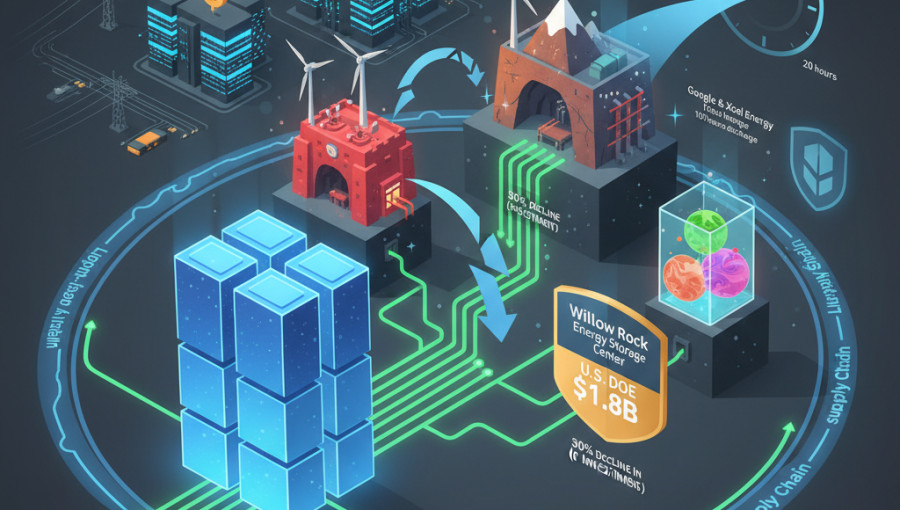
Global deployments of long-duration energy storage (LDES) grew by 49% in 2025, according to a recent Wood Mackenzie analysis. Despite this steady growth, emerging technologies face stiff competition from lithium-ion batteries, which benefit from maturing supply chains and rapid cost reductions. While the transition to renewable energy requires global grid storage capacity to jump from an average of 2.5 hours to 20 hours, lithium-ion is projected to maintain an 85% market share through 2034. High interest rates and shifting capital toward AI infrastructure have further complicated the investment landscape for alternative storage solutions.
The global energy landscape is witnessing a significant shift as the demand for longer discharge cycles intensifies. To maintain grid reliability while integrating more intermittent renewable energy, the industry must significantly extend storage durations. Currently, lithium-ion projects average approximately two hours of storage, whereas vanadium redox flow batteries (VRFB) and compressed air energy storage (CAES) average four hours. However, the dramatic cost reductions achieved by lithium-ion over the last decade have made it difficult for newer LDES technologies to gain a foothold.
Wood Mackenzie expects lithium-ion to remain the dominant force in the market for the next decade. Emerging LDES technologies, which are better suited for multi-day or seasonal storage, currently suffer from a lack of clear pricing mechanisms and insufficient market demand. While these technologies saw a massive 806% surge in deployments between 2023 and 2024, the more modest rise in 2025 reflects a tightening investment climate. Global funding for LDES fell by 30% last year, and venture capital investment dropped by 72% as investors pivoted toward AI data centers and traditional grid infrastructure.
Despite these financial headwinds, several landmark projects are advancing toward commercialization. In the United States, Hydrostor is preparing to break ground on the Willow Rock Energy Storage Center in California. This 500 MW facility will use CAES technology to store compressed air in underground caverns, providing up to eight hours of discharge over a 50-year operational lifespan. The project recently received a significant boost through a $1.8 billion commitment from the U.S. Department of Energy.
Innovation is also coming from iron-air battery technology. Form Energy has partnered with Google and Xcel Energy to support a new data center in Minnesota. This 300 MW deployment, boasting 30 GWh of capacity, is currently the largest battery project by energy capacity announced globally. Using a process described as “reversible rusting,” these batteries can discharge power for up to 100 hours, offering a solution for multi-day energy gaps. Google is also exploring CO2 batteries through a partnership with the Italian firm Energy Dome.
Policy support remains a primary driver for the sector. California has moved to procure 1 GW of multi-day energy storage to bolster its carbon-free goals. Utilities like Xcel Energy emphasize that LDES is essential for compliance with state laws mandating 100% carbon-free electricity. By maximizing the utility of renewable resources during periods of low solar and wind generation, long-duration systems ensure that the transition to a green grid remains both reliable and cost-effective for consumers.