
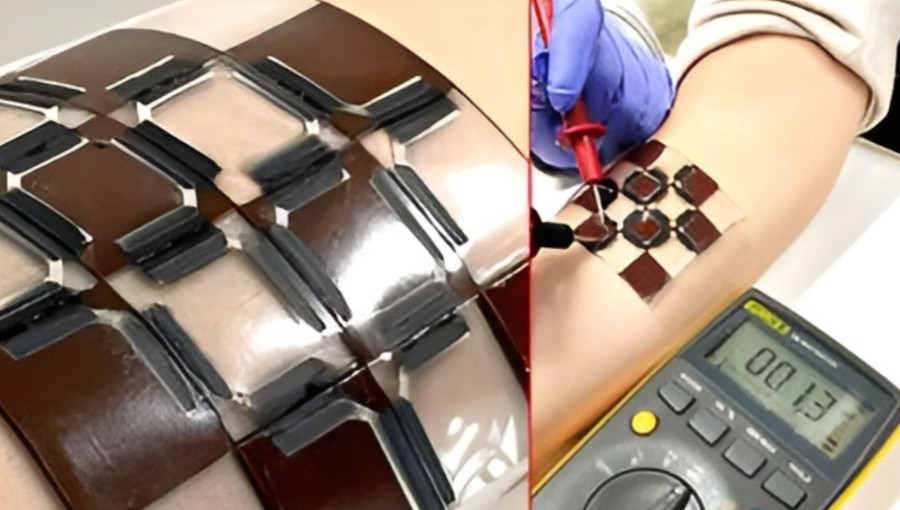
Researchers at Seoul National University have developed a flat, flexible thermoelectric device capable of converting body heat into electricity. Unlike traditional thermoelectric generators that require bulky 3D structures to maintain temperature differences, this new design uses a dual thermal conductivity substrate to manage heat flow across a thin surface. This innovation paves the way for self-powered wearable electronics, such as health monitors and smart fabrics, that are comfortable enough for daily use without the need for external batteries or frequent charging.
Wearable technology has long been constrained by the limitations of battery life and the physical bulk of power sources. While thermoelectric generators—devices that convert heat into electricity—have been proposed as a sustainable solution, they typically require a significant temperature gradient to function effectively. In thin, flat wearable applications, heat often passes directly through the material and dissipates into the air, leaving no thermal difference to exploit. Previous attempts to solve this involved creating 3D structures or bending the materials, which added uncomfortable thickness and undermined the primary advantages of wearable tech.
A research team at Seoul National University College of Engineering, led by Professor Jeonghun Kwak, has overcome this hurdle by developing what they call a “pseudo-transverse” thermoelectric generator. The device remains completely flat while maintaining the necessary temperature variations to produce power. The breakthrough centers on a specialized substrate made of stretchable silicone embedded with copper nanoparticles in specific patterns. This configuration creates zones with different thermal properties within a single layer, forcing heat to travel horizontally along high-conductivity paths rather than escaping vertically away from the skin.
By controlling the movement of heat within this thin film, the researchers have enabled efficient energy generation without sacrificing comfort or flexibility. This structural approach allows the device to function as a reliable power source for skin-attached sensors and smart textiles that move naturally with the body. Because the system utilizes an ink-based printing method, it is also highly scalable, allowing manufacturers to easily adjust the size and layout of the generators for various industrial or medical applications.
Professor Kwak noted that this technology addresses the fundamental limitations of conventional thin-film generators by providing a platform that generates electricity while remaining entirely planar. The study, which included contributions from researchers now at KU Leuven and the University of Seoul, was supported by the National Research Foundation of Korea. The full findings of this research have been published in the journal Science Advances, signaling a significant step toward a future of battery-free, self-sustaining wearable technology.
