
Spanish researchers have demonstrated that semi-transparent monocrystalline silicon solar modules can significantly enhance tomato yields while simultaneously generating clean energy. In a study comparing various agrivoltaic configurations, a silicon-based greenhouse system increased average fruit weight by 25% compared to traditional growing methods. Over two experimental seasons, the installation produced 726.8 kWh of electricity. By optimizing light transmission and maintaining superior soil and temperature conditions, this agrivoltaic approach offers a sustainable solution for Mediterranean agriculture, successfully balancing food production with renewable energy objectives.
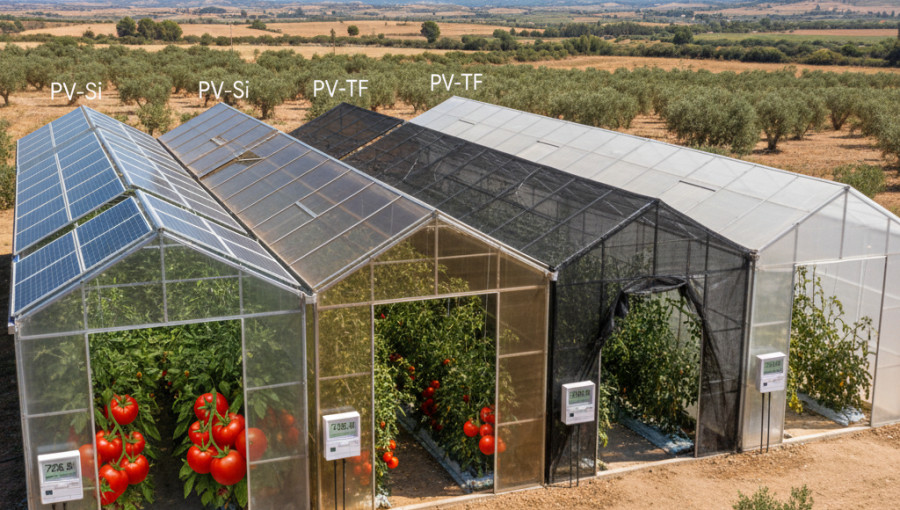
A research team led by the Murcian Institute for Agricultural and Environmental Research and Development (IMIDA) recently investigated how different levels of agrivoltaic shading influence tomato crop performance. Conducted in Murcia, Spain, the study utilized four identical greenhouses to compare two commercially available semi-transparent technologies: monocrystalline silicon (PV-Si) and cadmium telluride thin-film (PV-TF). These were tested against a standard polyethylene control greenhouse and one equipped with a traditional shading net.
The experimental structures were designed as polyethylene greenhouses measuring 3.1 meters in height, 3.9 meters in length, and 2 meters in width. For the solar-integrated versions, 18 solar modules with 50% transparency were installed across the roofs and south-facing façades. The silicon-based modules featured a nominal power of 59 W, while the thin-film modules were rated at 40 W. Throughout two growing seasons spanning from late 2023 to mid-2024, researchers monitored internal microclimates, including air and soil temperatures, humidity, and photosynthetically active radiation.
Data collected during the trial showed that the PV-Si system was the more efficient energy producer. During the winter-spring and spring-summer cycles, the silicon-based setup generated a total of 726.8 kWh, with a daily average of approximately 4 kWh. The PV-TF system followed with a total output of 488.4 kWh. Crucially, the silicon system maintained the Daily Light Integral (DLI)—the total amount of light received by the plants for photosynthesis—above the minimum threshold required for optimal growth, a benchmark the thin-film system often failed to meet.
The agricultural results were equally significant. While the total number of fruits remained relatively consistent across the different environments, the tomatoes harvested from the PV-Si greenhouse were 25% heavier than those from the control group. Scientists attributed this boost in mass to more favorable nighttime air temperatures and higher levels of soil moisture retention under the silicon solar modules. In the final spring-summer season, the silicon greenhouse produced tomatoes with an average weight of 93 grams, compared to 79 grams in the thin-film setup.
The research, which included contributions from Miguel Hernández University of Elche and the University of Bari Aldo Moro, concluded that semi-transparent silicon photovoltaics offer an ideal balance between thermal regulation and solar radiation management. The findings suggest that this specific agrivoltaic technology is highly suited for semi-arid Mediterranean climates, providing a viable pathway to maximize land use for both high-quality food production and renewable power generation.