
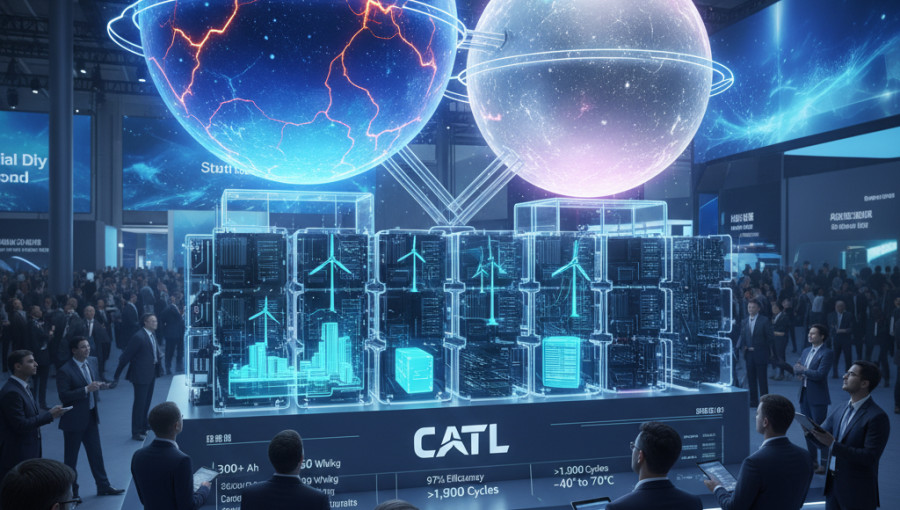
Global battery leader CATL has introduced its latest sodium-ion battery technology at the ESIE 2026 exhibition in Beijing. Specifically engineered for large-scale energy storage, the new cell marks a significant expansion of the company’s portfolio into utility-scale projects and AI data centers. By utilizing a design compatible with existing lithium-ion infrastructure, CATL aims to streamline the transition to sodium-based solutions. The battery promises high energy density and exceptional durability, with commercial deployment scheduled to begin within 2026.
During the Energy Storage International Conference and Expo (ESIE) 2026, CATL showcased its new sodium-ion battery under the theme of a “dual-star” approach, integrating both sodium and lithium technologies for comprehensive energy storage solutions. This new product represents the world’s first platform-based sodium-ion battery designed exclusively for the storage sector, moving beyond the company’s previous focus on automotive and auxiliary power applications.
A key advantage of the new battery is its physical compatibility with CATL’s established 587 Ah lithium storage cells. By sharing the same enclosure dimensions, the sodium-ion modules can be integrated into existing manufacturing lines and system designs with minimal adjustments. This strategic move is intended to lower switching costs for customers and simplify supply chain logistics as the industry adopts diverse chemistries.
Technical specifications for the large-format 300+ Ah cell are notable, featuring an energy density of approximately 160 Wh/kg and a system energy conversion efficiency of 97%. The battery is built for longevity, boasting a cycle life exceeding 15,000 cycles while maintaining 80% capacity retention. Furthermore, its robust thermal performance allows for reliable operation in extreme environments, with a functional temperature range spanning from -40°C to 70°C.
Industry experts suggest that sodium-ion technology will play a crucial role in regions with extreme climates. While lithium remains a staple for standard conditions, the resilience of sodium-ion cells in both freezing and high-heat scenarios makes them ideal for high-stress, high-load applications and thermal stability. CATL expects these batteries to be ready for full commercial deployment by 2026, providing a versatile alternative for grid-scale storage and the rapidly growing power demands of AI infrastructure.