
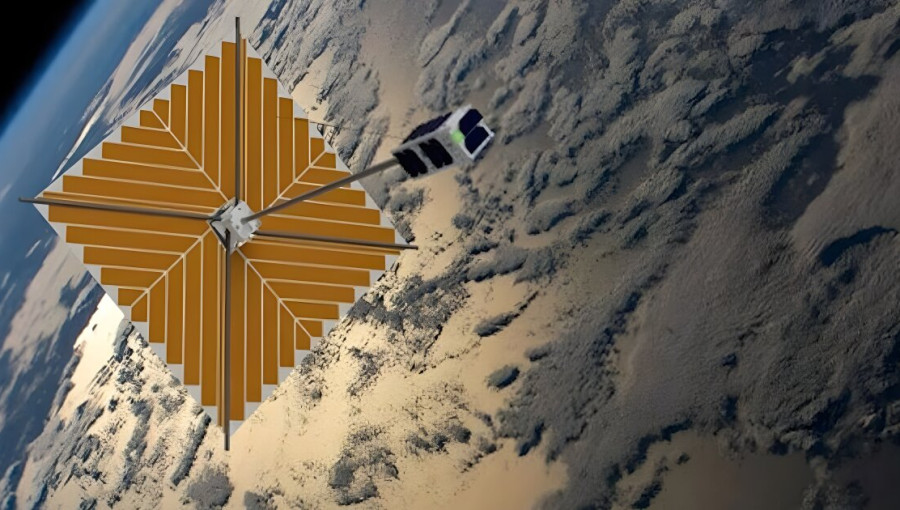
The Japan Aerospace Exploration Agency (JAXA) successfully launched its “Kakushin” Rising mission, deploying eight small satellites into a sun-synchronous orbit 540 km above Earth. A standout among these is a 10-cm CubeSat featuring a unique reflectarray antenna that utilizes origami principles to expand to 25 times its stowed size once in space. This mission aims to advance earthquake detection, ocean monitoring, and multispectral photography. By leveraging compact, cost-effective designs, JAXA continues to push the boundaries of orbital technology while significantly reducing launch expenses and development timelines.
The mission, which departed from Rocket Lab’s launch site on New Zealand’s Mahia Peninsula, marks a significant step in the Innovative Satellite Technology Demonstration Program. Approximately 53 minutes after liftoff, the Electron rocket precisely deployed the payload, which includes experimental hardware designed to detect electromagnetic precursors to earthquakes. This launch represents the second collaboration between JAXA and the private aerospace firm Rocket Lab in just five months, highlighting a growing reliance on agile, small-scale launch providers.
The centerpiece of the mission is the origami-inspired antenna, a concept deeply rooted in Japanese industrial design. The technology draws inspiration from the “Miura fold,” developed by Dr. Miura Koryo in 1970. This folding pattern allows large structures to be packed into incredibly small volumes and unfolded with a single motion. This principle was previously demonstrated in the 1995 Space Flyer Unit’s solar panels and the 2010 IKAROS mission, a “space yacht” that used radiation pressure on its origami-folded sail to travel 80,800 km to Venus without traditional fuel.
The shift toward CubeSats reflects a broader economic transformation in the space industry. Traditionally, weather or surveillance satellites could cost upwards of $390 million to build, with launch fees reaching up to $400 million. Massive communication satellites, such as the 6.91-tonne TerreStar-1, required an 18-m antenna and solar panels stretching 32 m, incurring astronomical insurance and transport costs. In contrast, CubeSats weighing between 1 kg and 10 kg can be developed by university teams for a fraction of the cost, making space more accessible for research and commercial ventures.
Technically, the new origami antenna functions as a low-cost reflectarray. Unlike traditional parabolic dishes, a reflectarray uses a planar surface to control the phase of reflected electromagnetic fields, creating a high-gain focused beam. This allows the satellite to maintain high performance while remaining flat and compact during transport. Future deployments may even utilize “rockoons”—rockets launched from high-altitude balloons—which aim to carry payloads of up to 140 kg into low-Earth orbit.
Rocket Lab CEO Sir Peter Beck noted that the successful deployment of these satellites reinforces the Electron rocket’s position as a leading choice for national space agencies. As the global CubeSat market reaches a valuation of $355 million, the integration of ancient folding arts with modern aerospace engineering is proving to be a vital strategy for efficient and affordable space exploration.