
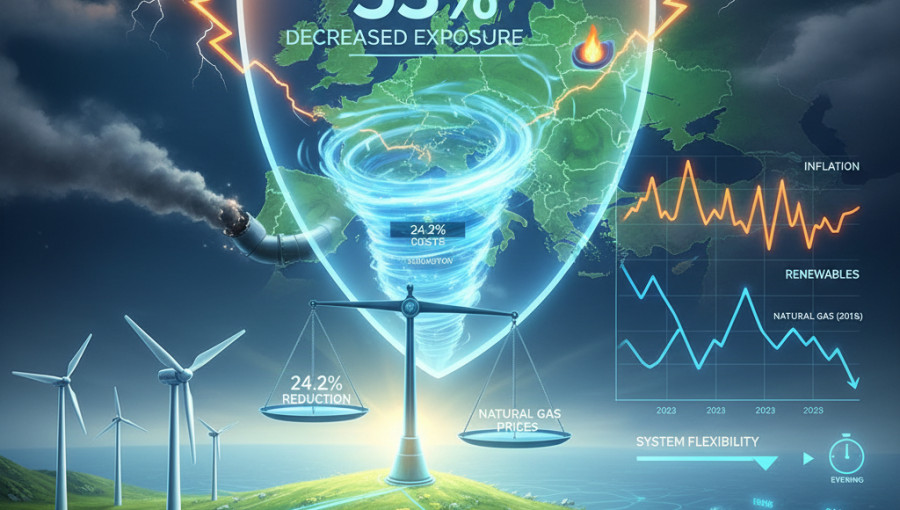
The rapid expansion of renewable energy has significantly lowered electricity costs in Spain, reducing wholesale prices by 24.2% between 2023 and 2025. According to a report by Positive Money, the Iberian Peninsula has successfully decoupled its power market from natural gas volatility, with Spain and Portugal now 53% less exposed to price shocks than they were three years ago. While the European Union remains vulnerable to geopolitical instability and high fossil fuel costs, the transition toward wind and solar power is proving to be a critical tool for long-term economic stability and energy independence.
The “Towards Cheaper Electricity” report highlights how the shift to green energy is fundamentally restructuring European power markets. Historically, the European Union’s heavy reliance on imported fossil fuels has left the continent susceptible to dramatic price spikes driven by geopolitical conflicts, such as the war in Ukraine and instability in the Middle East. These fluctuations have not only driven up household utility bills but have also fueled inflation and hampered the competitiveness of energy-intensive industries compared to those in the United States.
Spain has emerged as a primary success story in breaking this cycle. While Spanish wholesale electricity prices closely mirrored gas prices as recently as 2018, the correlation has weakened significantly. By 2025, market prices frequently dipped below levels dictated by gas costs, a direct result of the massive influx of renewable generation. This stands in stark contrast to markets like Italy, where natural gas remains the dominant benchmark for pricing due to a slower transition.
The downward pressure on prices is driven by two primary market mechanisms. First, renewable energy sources displace more expensive fossil fuel plants within the European marginal pricing system, effectively lowering the cost of the final unit of energy needed to meet demand. Second, as wind and solar power penetration increases, these sources often set the market price themselves due to their near-zero variable costs. This effect is particularly pronounced in nations with strong nuclear or hydropower foundations, which further reduce the need for gas-fired generation.
Despite this progress, the report notes that the decoupling of gas and electricity prices is not yet complete across the EU, largely due to the interconnected nature of national power grids. To fully realize the benefits of the transition, experts argue that massive renewable deployment must be paired with enhanced system flexibility. In Spain, rising renewable output has led to significant intraday price fluctuations, with costs dropping during the day and peaking in the evening. This volatility is creating a powerful economic case for investment in battery storage and other flexibility technologies to stabilize the grid and maximize the value of green energy.