
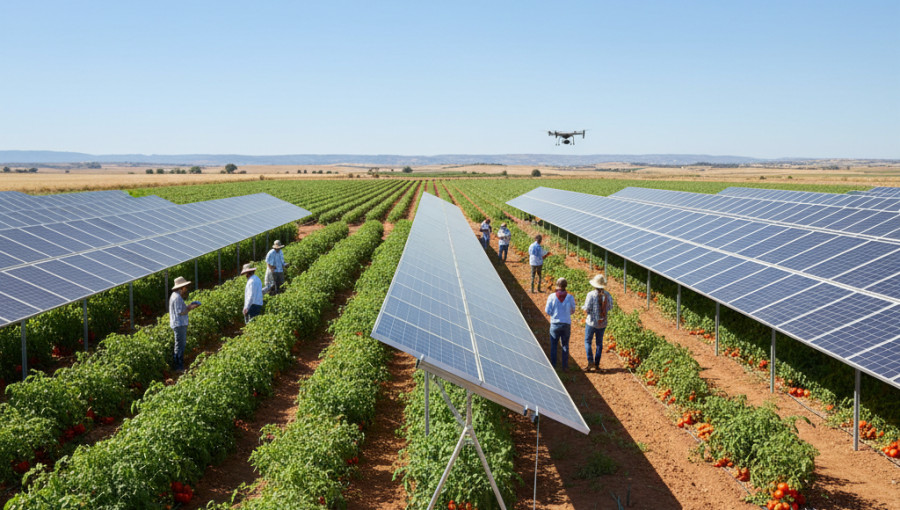
Spanish researchers have demonstrated that integrating agrivoltaic systems with regulated deficit irrigation (RDI) can reduce water consumption in tomato cultivation by approximately 50%. The study, conducted in Madrid and Seville, highlights how the shade from solar panels lowers evaporative demand while simultaneously generating clean energy. Although tomato yields saw a 20% decrease due to water stress, the overall land-use efficiency and water productivity improved significantly. This innovative approach offers a sustainable solution for agricultural regions facing water scarcity, proving that dual-use land management is more efficient and potentially more profitable than traditional farming or energy production alone.
The research, published in the journal *Agricultural Water Management*, involved a collaboration between the Technical University of Madrid, the University of Seville, and several other Spanish institutions. By utilizing RDI, a method that strategically limits water during a plant’s less sensitive growth phases, scientists were able to monitor leaf water potential to prevent excessive stress while maximizing resource efficiency. This technique was tested alongside control plots that received full irrigation to compare growth and resource consumption.
The experimental setups in Madrid and Seville utilized structures holding 450 W monocrystalline silicon solar modules. In Madrid, these solar panels were mounted at a height of 2.5 meters, while the Seville site featured 3-meter-high structures. The researchers adjusted the tilt and orientation of the solar module arrays to optimize both energy capture and the microclimate for the tomato plants growing beneath them. The configuration was designed to allow enough radiation for plant development while providing protective shade during peak temperature periods.
Data collected during the 2024 growing season revealed that the agrivoltaic shading significantly influenced the local microclimate. In Madrid, the solar panels reduced midday photosynthetically active radiation by roughly 90%, which helped lower daytime temperatures during peak heat. In contrast, the Seville site experienced higher ambient temperatures, where the panels occasionally trapped heat, though they still contributed to a more efficient use of the available land compared to open-field farming.
While the drastic reduction in irrigation led to a 20% decline in total tomato yield, the study found that the water productivity—the amount of fruit produced per unit of water—actually increased in the Seville trials. Furthermore, the Land Equivalent Ratio (LER), a metric used to measure the efficiency of dual-purpose land, reached 1.54 in Madrid and 1.67 in Seville. These figures confirm that producing food and electricity on the same plot is substantially more efficient than separating the two activities.
The research team concluded that the combination of solar energy production and advanced irrigation techniques provides a viable path forward for sustainable agriculture. By generating renewable energy and conserving water, the system enhances the long-term sustainability of farming operations in arid and semi-arid climates. This study marks a significant step in optimizing agrivoltaic designs to balance the needs of food production and the transition to green energy.