
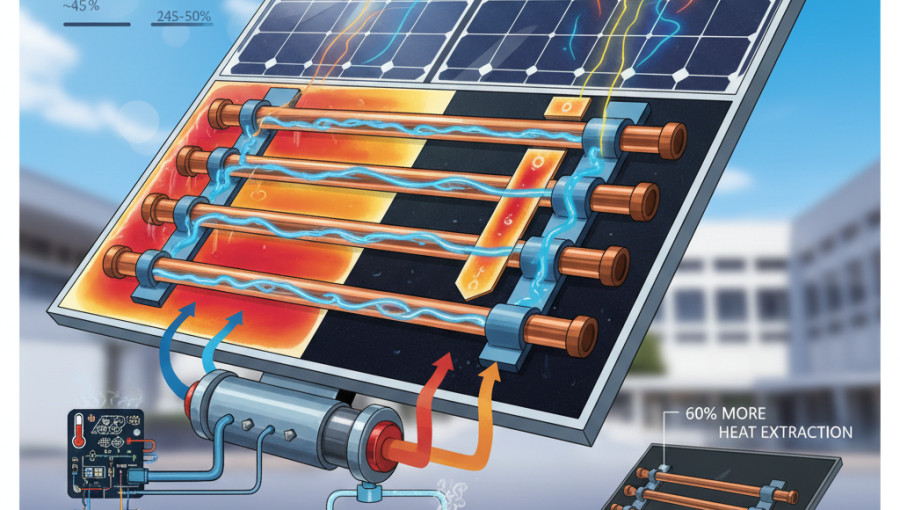
Researchers at the Federal University of Paraná in Brazil have demonstrated that retrofitting standard commercial solar panels into photovoltaic-thermal (PVT) modules can significantly increase total energy efficiency to nearly 50%. By integrating copper thermosyphons onto the back of polycrystalline modules, the team achieved effective heat recovery for low-grade thermal applications. However, the study revealed that added thermal resistance currently limits electrical performance. To reach optimal parity with standard panels, the researchers suggest that heat extraction capacity must be increased by approximately 60% through improved design and better thermal contact.
The research focused on bridging the gap between custom-designed PVT collectors and mass-produced commercial solar modules. While most existing studies utilize optimized, purpose-built systems, the Brazilian team explored the technical and economic feasibility of modifying standard hardware already available on the market. The study utilized thermosyphons—passive heat transfer devices that rely on phase-change mechanisms and gravity to move heat away from the solar cell without the need for complex capillary structures or mechanical pumps.
For the experimental setup, the scientists modified a 60 W polycrystalline solar module by mounting four copper thermosyphons filled with distilled water to its rear surface. Aluminum absorber bars were used to facilitate thermal contact between the panel and the heat pipes. To manage the heat, the condenser sections of the thermosyphons were integrated into a water-cooled manifold connected to a closed-loop system featuring a thermal reservoir and a flow meter. This allowed the team to store and measure the recovered thermal energy while comparing the unit’s performance against a standard reference panel.
Field tests conducted under various weather conditions revealed that the PVT system reached a total energy efficiency of 45.75% on sunny days. Interestingly, efficiency climbed above 50% during cloudy periods, as the system’s thermal inertia allowed it to continue releasing stored heat even when solar irradiance fluctuated. Despite these gains in total energy output, the researchers identified a “thermal penalty.” The retrofitted module consistently operated at higher temperatures than the reference panel because the added hardware restricted natural convection at the rear, leading to a slight decrease in electrical efficiency.
The study highlighted that water flow rates are a critical factor in system regulation. At a flow rate of 6.5 L/min, the system maintained stable cooling and better electrical output. Conversely, reducing the flow to 1.5 L/min led to significant overheating, causing electrical efficiency to drop to 10.93% and total efficiency to plummet to 19.02%. The data suggests that simply increasing the flow rate is not enough to overcome the inherent thermal resistance of the retrofit interface.
To address these limitations, the academic team concluded that the current four-thermosyphon configuration is undersized. They recommend increasing the number of thermosyphons to six or seven and enhancing the thermal contact area to achieve a 60% boost in heat extraction capacity. Future research will focus on optimizing these spatial configurations, exploring alternative working fluids, and assessing the long-term economic viability of scaling this technology for building-integrated applications.