
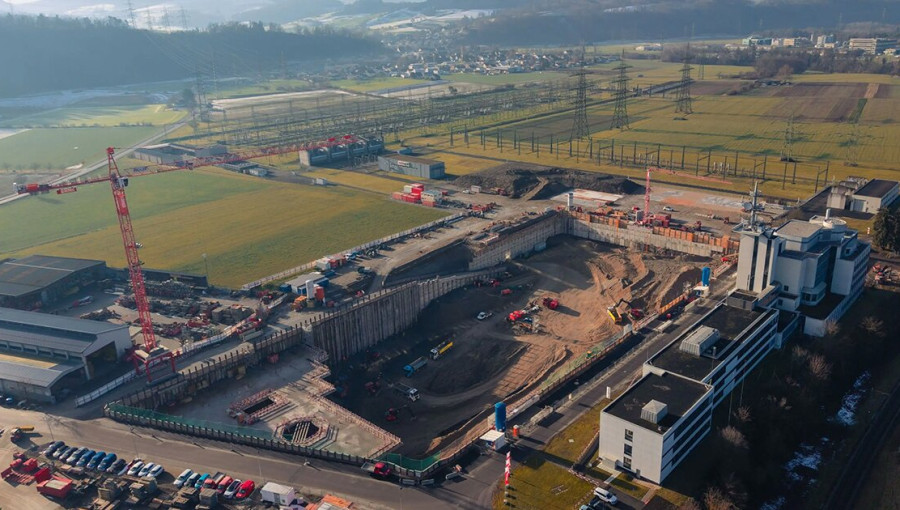
Swiss energy company FlexBase has commenced construction on the world’s largest redox flow battery in northern Switzerland. The billion-dollar project, featuring a 2.1 GWh capacity, aims to stabilize European power grids and support energy-intensive AI data centers. By utilizing liquid electrolyte technology, this massive storage facility will provide a sustainable, non-flammable alternative to lithium-ion systems. Once operational in 2029, the site will cover approximately 20,000 square meters, offering enough stored energy to power 210,000 households for a full day, marking a significant milestone in large-scale clean energy infrastructure.
Excavation is currently underway in northern Switzerland for a massive underground energy storage facility near the German border. The construction team is digging a pit that will reach a depth of approximately 27 meters and span the length of two soccer pitches. This ambitious infrastructure project represents the first redox flow battery in Switzerland and is poised to become the most powerful facility of its kind globally.
While lithium-ion batteries are common for short-term needs, redox flow technology is specifically designed for long-term, grid-scale applications. The system functions by storing energy in liquid electrolytes held in large tanks. During the charging process, ions pass through a membrane to change their oxidation state, allowing energy to be stored indefinitely without the risk of degradation or fire. FlexBase co-founder Marcel Aumer noted that the facility would be capable of rapid energy absorption and injection, matching the output of the nearby Leibstadt nuclear power plant.
The primary goal of the 2.1 GWh battery is to mitigate the volatility of renewable energy sources. By storing excess energy generated by wind turbines, the facility can prevent blackouts and stabilize the broader European power grid during periods of peak demand. Furthermore, the site is strategically positioned to meet the high electricity requirements of local AI data centers. With a capacity significantly higher than the current 700-MWh record-holder in China, this project underscores a major shift toward industrial-scale storage solutions.
The total investment for the project is expected to exceed one billion dollars. As the industry has matured, the costs for essential components such as cell stacks, membranes, and pumps have decreased, making large-scale deployment more economically viable. Beyond its functional benefits, the battery is almost entirely recyclable and boasts a nearly limitless service life because its charge cycles are chemically inert.
Scheduled for completion in 2029, the battery will be the centerpiece of a 20,000-square-meter technology hub. This complex will not only house the massive storage tanks but also include specialized laboratories, offices, and a data center. This development places Switzerland at the forefront of the global energy transition, joining nations like Japan and Germany in the race to master large-scale redox flow technology.