
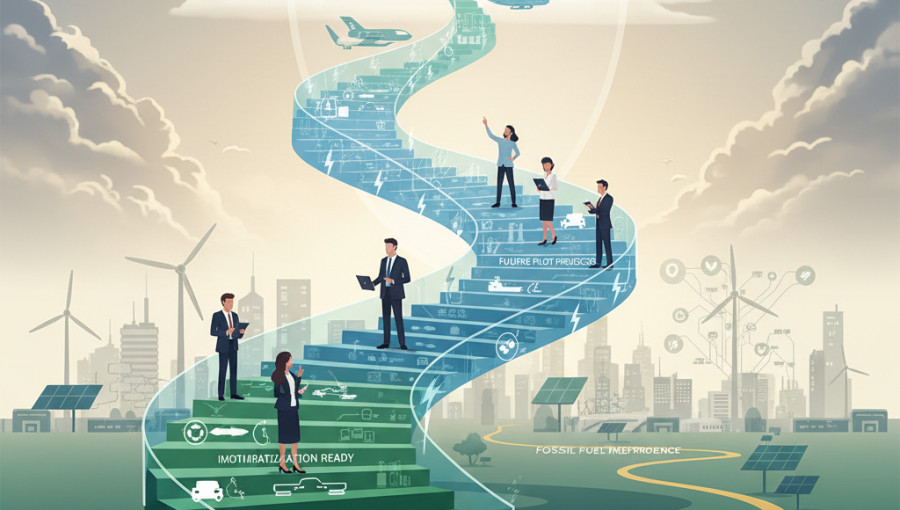
Michael Liebreich has introduced the “Electrification Staircase,” a strategic framework designed to prioritize the transition to electric power across various industrial and consumer sectors. Developed in collaboration with leading energy specialists, the tool serves as a roadmap for policymakers and investors to identify which technologies are ready for immediate deployment and which require further development. By categorizing electrification efforts into logical steps, the Staircase aims to streamline the global push toward deep decarbonization, reduce CO2 emission levels, and enhance energy security against volatile fossil fuel markets.
The global energy discourse is undergoing a significant pivot as electrification takes center stage as the primary pathway to a sustainable future. According to Liebreich, deep electrification offers the most cost-effective method for incremental decarbonization once power grids become sufficiently clean. This shift is increasingly viewed as a vital defense against the volatility of international oil and gas markets, a sentiment already being embraced by major economies and the rapidly growing market for electric vehicles.
The Electrification Staircase was developed to address the practical challenges of transitioning complex systems. While some sectors can be electrified immediately to achieve significant cost savings, others remain in the experimental phase. The framework was created alongside Adrian Hiel of the Electrification Alliance, Dr. Silvia Madeddu, an expert in industrial electrification, Thomas Butler of the Regulatory Assistance Project, and William Drake of EcoPragma Capital. Together, they sought to provide a nuanced view of the transition that accounts for both technical feasibility and economic readiness.
Unlike the previously influential Hydrogen Ladder, which focused on the long-term viability of hydrogen use cases by 2035, the Electrification Staircase introduces a critical time dimension. It distinguishes between technologies that should be rolled out at scale today and those that currently serve as commercialization pilots for future decades. This distinction is intended to help executives and government ministers navigate the “primetime” readiness of various use cases, ranging from light transport to heavy industrial heat processing.
A primary goal of the initiative is to move past the polarized debates that often stall climate action. By providing a shared vocabulary and a visual progression, the creators hope to bridge the gap between “electrify everything” advocates and those who favor a more cautious approach. The Staircase suggests that the transition does not need to happen all at once; rather, stakeholders should focus on sequential progress, starting with the most viable options first and moving up the steps as technology matures.
The framework has been released under a Creative Commons license, encouraging widespread use and adaptation by the global energy community in reports and policy planning. Liebreich emphasized that the Staircase is intended to be a living document, inviting feedback and data-driven disagreements to refine future iterations. As the world moves toward the goal of 50% electrification, the tool is expected to evolve to meet the changing technical and economic landscape of the global energy transition.
https://mliebreich.substack.com/p/the-electrification-staircase-is