
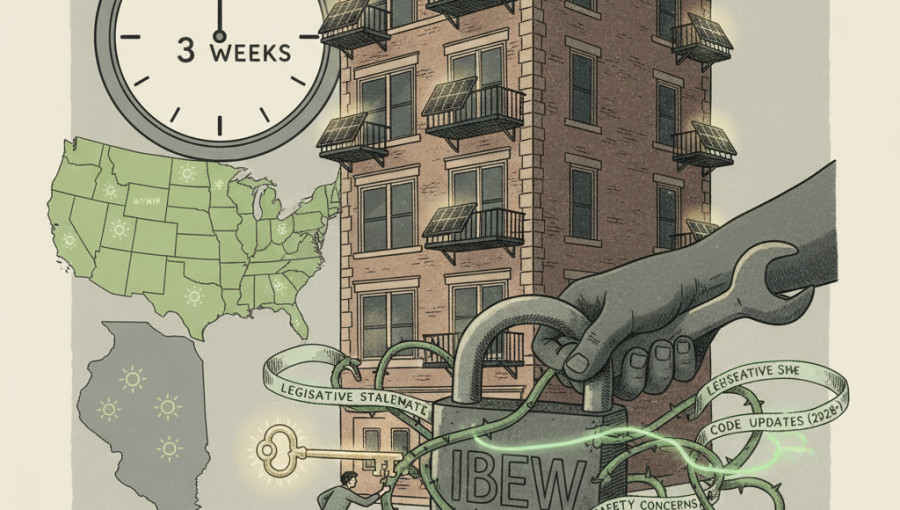
An Illinois legislative effort to legalize balcony solar systems has stalled for the year following a stalemate between clean energy advocates and labor unions. Despite growing national momentum for plug-in solar technology, proponents of Senate Bill 3104 withdrew the measure after safety concerns raised by the International Brotherhood of Electrical Workers led to restrictive amendments. These changes would have delayed the adoption of small-scale solar panel arrays until at least 2028. Supporters emphasize that such technology provides accessible renewable energy for renters and homeowners without threatening traditional electrical installation jobs.
The push for balcony solar in Illinois has officially ended for the current legislative session as lawmakers failed to find common ground with powerful labor interests. The primary roadblock came from the International Brotherhood of Electrical Workers (IBEW), which raised safety objections that ultimately led to a legislative deadlock. While advocates had hoped to streamline the process for residents to use small-scale solar module systems, a recent amendment proposed a total ban on the technology until national electrical safety standards are updated, a process not expected to conclude for several years.
The original legislation sought to simplify the adoption of plug-in solar arrays by removing the requirement for utility interconnection agreements for systems up to 1,200 watts. Furthermore, it aimed to prevent landlords and homeowners’ associations from blocking installations of 391 watts or smaller. Proponents of the bill argue that these systems are essentially household appliances, comparing the safety of plugging in a solar panel to that of a hair dryer or washing machine. They also pointed out that the bill required certification from safety organizations like UL Solutions to ensure consumer protection.
Illinois now trails several other states that have recently embraced balcony solar. Utah, Maine, and Colorado have already passed similar legislation, while Maryland and Virginia have recently moved similar bills toward final approval. In contrast, the Illinois debate echoed recent failures in Oregon, where union opposition also centered on safety and technical standards. Clean energy groups expressed disappointment, noting that even labor-heavy states like New York have shown unanimous support for similar measures in their legislative chambers.
Advocates stress that balcony solar serves a distinct market from traditional rooftop installations and does not compete with the large-scale projects that employ union electricians. These small systems are designed for appliance-level energy savings rather than full-scale power generation. While the bill’s sponsors have decided to pause their efforts for now, they remain optimistic about the future. Given the history of clean energy legislation in Illinois, supporters anticipate that it may take multiple sessions to refine the policy and secure the necessary support for a statewide rollout.
