
Solar energy development is entering a new era as projects transition from megawatt-scale installations to massive, multi-gigawatt power plants. Driven by falling costs and improved installation techniques, developers are increasingly targeting remote, sun-rich regions to create vast energy hubs. This shift requires unprecedented levels of land access, workforce mobilization, and transmission infrastructure. From the salt flats of India to the high-altitude plateaus of China and the agricultural lands of California, these giga-scale projects are transforming how electricity is generated and stored, positioning the world’s most isolated areas as vital breadbaskets for clean, renewable power.
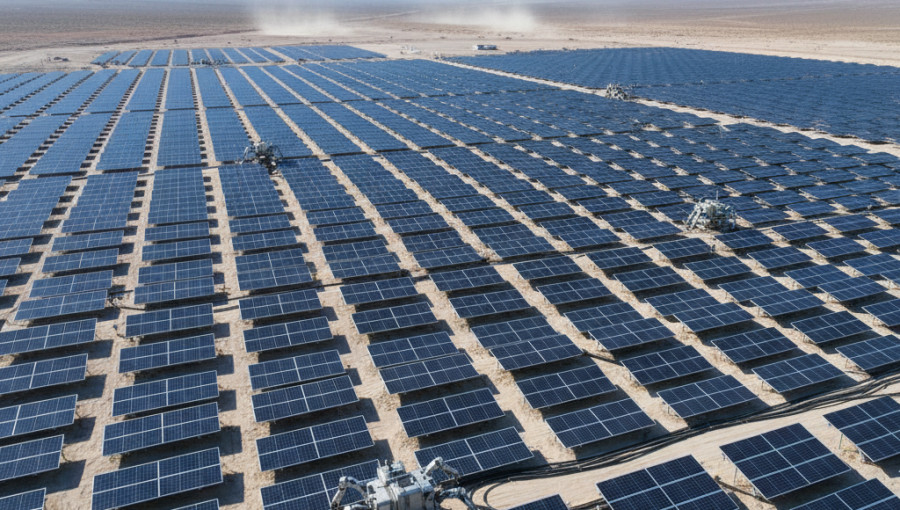
In India, the Adani Group is spearheading a monumental project in the Rann of Kutch, a challenging salt flat in Gujarat. This site is designed to reach 30 gigawatts of combined wind and solar capacity. To support a workforce of 15,000, the company constructed its own desalination plant and fiber-optic network. The facility already utilizes robotic cleaners to maintain its solar panels and has integrated a massive 1.1-gigawatt grid battery, allowing the company to store energy and sell it during peak evening hours. This storage capacity is among the largest of its kind globally.
China is also aggressively pursuing giga-scale solar, particularly on the Tibetan Plateau, where high elevations and cool air enhance the efficiency of solar modules. The Talatan Solar Park in Qinghai Province has grown to nearly 17 gigawatts, covering an area equivalent to seven Manhattans. By installing panels at heights that allow for sheep grazing, the project balances energy production with local land use. China’s rapid deployment of these massive solar clusters now sees the country adding solar capacity equivalent to the Three Gorges Dam project every three weeks.
In the United States, the Westlands Water District in California is proposing a 21-gigawatt solar complex on fallow agricultural land. This ambitious project aims to double the state’s current utility-scale solar capacity. Unlike the centralized planning seen in India or China, the Westlands initiative relies on a coordinated local strategy to manage land use, transmission, and water infrastructure. By incorporating community benefits and supporting farmers, the project serves as a potential model for how the U.S. can scale renewable energy while helping regions adapt to environmental changes and phase out fossil fuel reliance.