
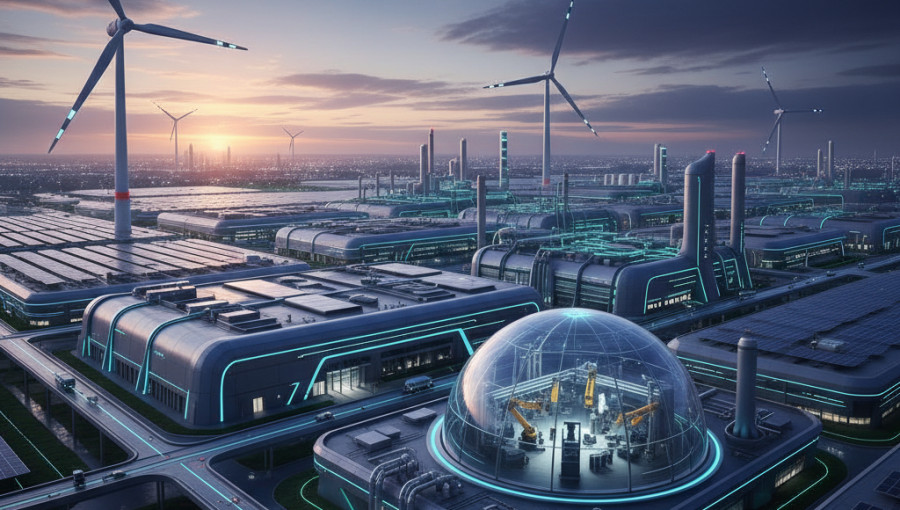
European industry remains highly vulnerable to volatile fossil fuel prices, as demonstrated by the 2022 gas crisis and ongoing geopolitical tensions. A new report, High Voltage, challenges the perception that industrial energy demand is too difficult to decarbonize. By synthesizing global mitigation scenarios, the analysis reveals that industrial electrification could reach 51% by 2050 under strong climate policies, with the potential to climb as high as 85%. Rather than a technical limitation, the transition depends on strategic infrastructure investment, affordable clean power, and policy frameworks that prioritize electrification as a primary tool for long-term industrial stability.
The industrial sector currently accounts for 29% of global CO2 emissions, largely due to the combustion of fossil fuels for heat. While often labeled as “hard-to-abate,” the report highlights that existing technologies—such as industrial heat pumps, electric boilers, and electro-thermal storage—are already capable of replacing fossil fuels for low and medium-temperature processes. These solutions offer an immediate reduction in emissions that compounds as the power grid becomes cleaner. Transitioning to electricity provides a structural defense against the price shocks associated with internationally traded fuels, allowing factories to rely on domestic wind and solar energy.
Realizing this potential requires overcoming economic and structural barriers, such as the current disparity between electricity costs and gas prices. Because industrial assets are capital-intensive and long-lived, firms require policy certainty to justify the upfront costs of electrification. The report advocates for immediate actions, including the removal of disproportionate levies on electricity, the streamlining of grid connections and permitting, and the use of financial tools like clean heat premiums and tax credits to bridge the price gap. Targeted support is also necessary for high-temperature sectors like steel and cement, where plasma torches and induction heating are emerging as viable solutions.
The European Union has begun to address these needs through the Innovation Fund Heat Auction, the world’s first dedicated instrument for industrial heat electrification. Following a successful pilot that awarded €400 million to 65 projects, the European Commission has committed to a second round in 2026 with a €1 billion budget. By establishing this as a recurring instrument rather than a one-off event, policymakers are providing the investment predictability required for long-term industrial planning. Ultimately, the transition to an electrified industrial base depends on the decisions made during this decade regarding grid infrastructure and equipment replacement cycles.