
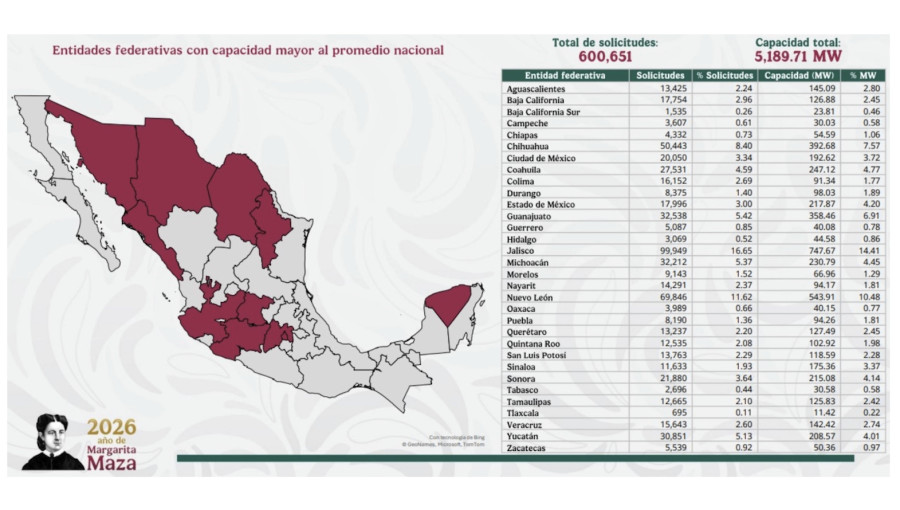
Mexico has achieved a significant renewable energy milestone, surpassing 5 gigawatts of distributed solar power capacity by the end of 2025. With over 600,000 installations nationwide, the country’s small-scale solar sector has attracted more than $13 billion in total investment. This rapid expansion is largely attributed to the success of net metering policies, which allow rooftop solar owners to feed excess electricity back into the grid. While small-scale systems dominate the landscape, the state of Jalisco remains the national leader, hosting nearly 100,000 individual installations and contributing substantially to the country’s overall solar energy output.
Data from the National Energy Commission indicates that Mexico reached 5,164.98 megawatts of distributed solar capacity through 600,368 distinct installations. When considering all power plants with a capacity under 0.7 megawatts, the total rises to 5,189.71 megawatts across 600,651 systems, with solar technology accounting for 99.5% of these projects. Net metering has proven to be the primary catalyst for this growth, with 593,607 applications linked to the program, representing 5,113.14 megawatts of installed capacity.
The distribution of these solar systems shows that smaller projects are the most numerous. Systems with a capacity of up to 50 kilowatts make up 98.23% of net-metered applications, providing 3,251.46 megawatts of power, which equates to 63.59% of the total capacity under this framework. Conversely, larger systems ranging from 250 kilowatts to 500 kilowatts represent a smaller fraction of total applications at 0.40%, yet they contribute 989.02 megawatts, or 19.34% of the net-metered capacity.
Regionally, Jalisco stands out as the hub for distributed solar energy in Mexico. By the conclusion of last year, the state had recorded 99,949 installations, generating 747.67 megawatts of power capacity. Given the consistent pace of development, it is expected that the state has since exceeded the 100,000-installation mark, further cementing its role as a leader in the nation’s transition toward decentralized renewable energy.