
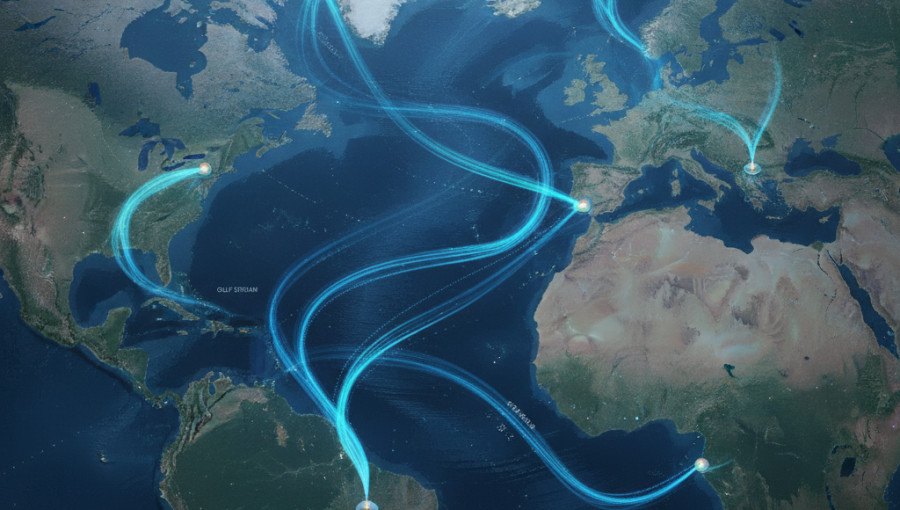
The Atlantic Meridional Overturning Circulation (AMOC), a vital system of ocean currents that transports tropical heat to Europe, appears more resilient than previously feared. While climate models have long warned that global warming could trigger a catastrophic collapse of this “conveyor belt” by freshening North Atlantic waters, recent data from the RAPID and OSNAP mooring arrays suggest the system is complex and potentially more stable. Although some evidence shows a gradual weakening, researchers increasingly view the dramatic “collapse” scenarios as oversimplified, noting that the AMOC may be a series of semiautonomous currents rather than a single, fragile loop.
For over two decades, the RAPID array has monitored the AMOC at 26°N, using instrument-packed moorings to track density-driven flows. These currents are essential for keeping Northern Europe temperate and sequestering heat and carbon dioxide in the deep ocean. While early climate models predicted that melting ice sheets and warmer, fresher surface waters would halt the sinking process that powers the AMOC, real-world observations have yet to confirm a total shutdown. Instead, the data reveal significant natural variability, with the circulation experiencing periods of decline followed by recovery, often influenced by atmospheric pressure and wind patterns.
Newer research, including data from the OSNAP array spanning the subpolar North Atlantic, has further challenged the traditional conveyor belt analogy. Scientists have discovered that deep-water formation—the engine of the AMOC—is occurring in unexpected locations, such as the Irminger and Iceland basins, and may even be migrating into the Arctic. This suggests the circulation possesses a level of geographic flexibility that could buffer it against the impacts of climate change. Recent high-resolution climate simulations have also shown that even under extreme warming scenarios, the AMOC may weaken significantly but ultimately rebound rather than collapse.
Despite these findings, the potential for a weakened AMOC remains a serious concern. A slowdown could still trigger significant regional shifts, including colder winters in Europe, rising sea levels along the U.S. East Coast, and disruptions to tropical rainfall patterns. While researchers caution against the alarmist rhetoric surrounding a total system failure, they emphasize that even a partial decline could have meaningful environmental consequences. As funding for monitoring arrays remains uncertain, scientists are working to refine their understanding of these currents, moving away from simplistic models toward a more nuanced view of how the Atlantic will respond to a warming planet.