
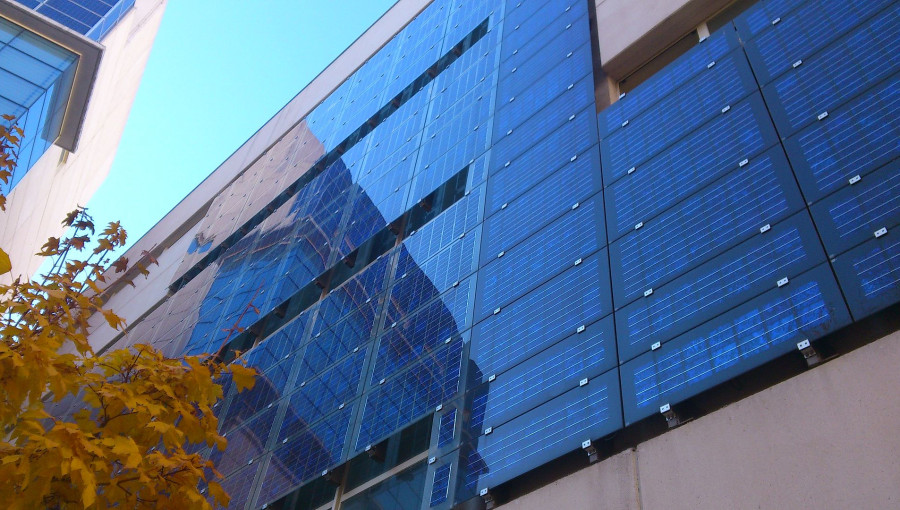
Researchers at Germany’s Institute for Solar Energy Research Hamelin (ISFH) have found that integrating battery storage with south-facing photovoltaic (PV) facades significantly enhances their economic viability, countering previous perceptions of such installations being too expensive or ineffective. Lead researcher Dennis Bredemeier highlighted that their study demonstrated a drastic increase in the utilization of these solar systems—rising to over 80% in many parts of Europe when battery storage is included, compared to only around 30% without it.
The researchers conducted their techno-economic analysis targeting the year 2030, assuming capital expenditures (CapEx) of €760 ($882) per kW for PV panels and €150 per kWh for battery storage. They noted that this low cost for batteries is facilitating their widespread installation across Europe, which in turn unlocks the full potential of south-facing facades. Bredemeier also referenced a recent study suggesting that the actual costs could be even lower than the figures they used, calling into question the pessimism often associated with cost projections for renewable technologies.
Their analysis considered various factors including operational expenditures (OpEx), retail electricity prices, and revenues from excess electricity fed into the grid, deliberately excluding public incentives. Bredemeier explained that they estimated a feed-in tariff of €0.02 per kWh, reflecting what could realistically be achieved on the electricity market by 2030, making these solar facades potentially economically viable without subsidies—especially when compared to PV on east- or west-facing rooftops.
Furthermore, the study conducted a sensitivity analysis comparing costs of facade modules with standard ones, assuming a 20% higher cost for the former. Despite this, the findings indicate that solar facades are still being implemented widely. The researchers pointed out that while higher costs for Building-Integrated Photovoltaics (BIPV) would make facades less appealing, the dual benefits of providing energy and serving as a building facade enhance their value.
In a detailed case study of a single-family house equipped with a solar facade, the findings showed that the ratio of installed solar power on south facades to total installed PV power could reach approximately 80% with battery storage, especially in regions between 45°N and 65°N, whereas it remains about 30% without battery integration. This trend becomes even more favorable when factoring in higher energy demands for heating and cooling in buildings. The results of this research have been documented in their paper titled “Falling costs for battery storages make facade photovoltaic systems more attractive for prosumers,” published in the journal Applied Energy.