
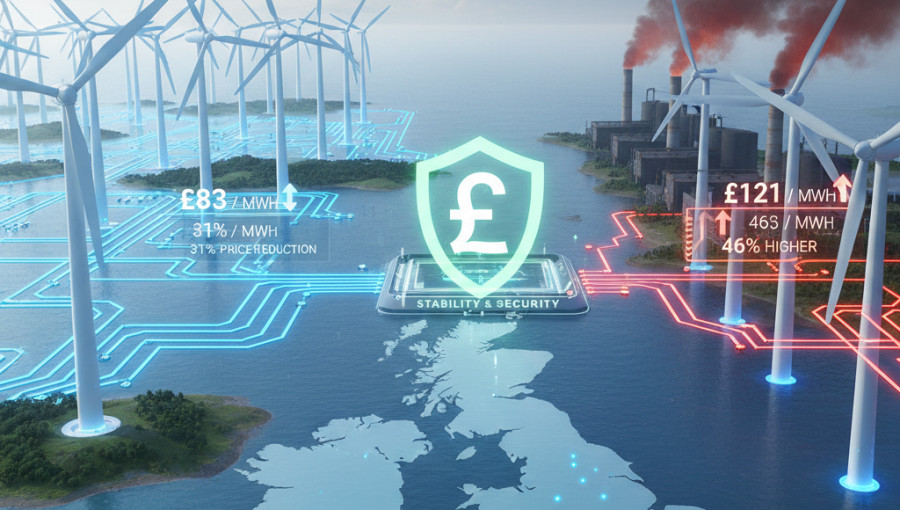
New data from the Energy and Climate Intelligence Unit (ECIU) reveals that British wind farms significantly lowered wholesale electricity costs last year, reducing day-ahead prices by nearly a third. Without wind generation, prices would have surged from £83 per megawatt-hour to an estimated £121 per megawatt-hour. By displacing expensive gas-fired power plants, the growing fleet of wind turbines is providing a crucial buffer against volatile international gas markets and the long-term decline of North Sea production, reinforcing the role of renewables in ensuring national energy stability.
The expansion of wind energy across Great Britain has become a primary driver in lowering wholesale electricity prices, according to the latest analysis by the ECIU. During the past year, the average price for electricity traded on day-ahead markets settled at approximately £83 per megawatt-hour (MWh). However, the report indicates that these costs would have reached £121 per MWh if wind generation had not been available to push gas power plants out of the price-setting process.
This £38 per MWh reduction represents a 31% saving for the energy market, a notable increase from the 25% savings recorded in 2024. This trajectory highlights a long-term trend where the increasing capacity of the British wind fleet consistently limits the influence of fossil fuels on power pricing. Currently, the UK operates over 29 GW of wind capacity, with an additional 10 GW currently under construction to further bolster the grid.
Energy analysts suggest that the shift toward homegrown renewables is essential for economic resilience. As North Sea gas reserves continue their decades-long decline, the UK will increasingly rely on imports to fuel gas power plants. By utilizing wind turbines and solar panel installations, the country can mitigate the impact of global geopolitical turmoil and fluctuating commodity prices. Experts note that once a wind turbine or solar panel is operational, the energy source is free, removing the need to pay foreign entities for fuel.
The findings come at a pivotal moment for the industry, as the government prepares to announce the results of the latest Contracts for Difference (CfD) auction, known as Allocation Round 7 (AR7). These auctions are critical for determining the next phase of offshore wind development. Industry leaders emphasize that continuing this momentum is vital for protecting both industrial consumers and households, many of whom are still recovering from the financial strain caused by recent global energy crises.