
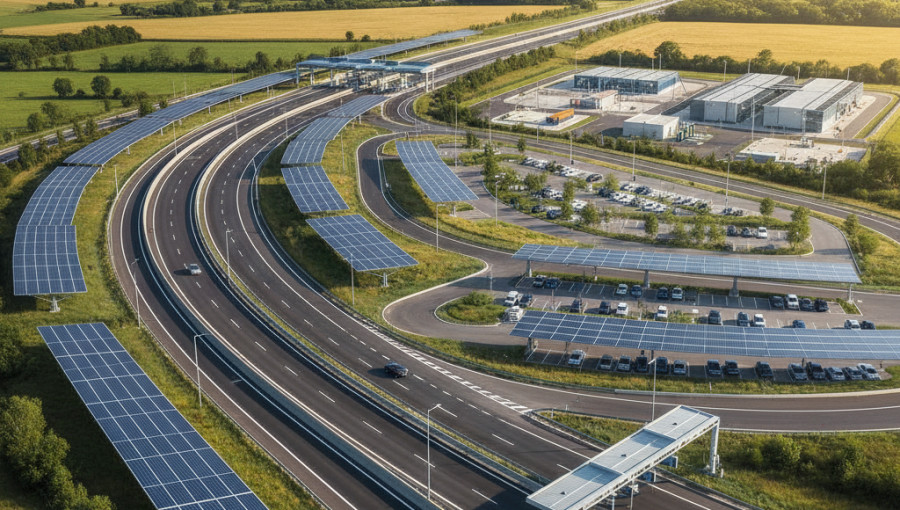
Croatia is advancing a plan to transform unused land along its major highways into a source of renewable energy. The national highway operator, Hrvatske Autoceste (HAC), has commissioned project designs for photovoltaic power plants at four locations spanning 36 hectares along the A3 highway, which connects the capital, Zagreb, to the Serbian border. This “solar highways” initiative is a key component of HAC’s strategy to power its own infrastructure and support a significant expansion of its electric vehicle charging network, with a final decision on construction expected after 2027.
Following a competitive tender, HAC selected the firm ETS Farago to develop the technical blueprints. The design phase, valued at approximately EUR 11,400, is slated for completion by March 2026. The designated sites include land adjacent to rest areas at Zagreb Plitvice (2.5 hectares) and Rastovica (3.1 hectares), as well as larger plots at the Sredanci (11 hectares) and Ivanja Reka (18 hectares) interchanges. ETS Farago’s brief includes a comprehensive assessment of the project’s feasibility and a techno-economic analysis, which will guide the final decision on whether to proceed with a tender for the installation of solar panels.
The design study will explore three distinct operational models for the proposed solar farms. The first option involves generating electricity primarily for HAC’s self-consumption—powering toll booths, maintenance centers, and lighting—with any surplus energy being sold to the grid. A second scenario adds battery energy storage systems (BESS) to the self-consumption model for enhanced energy management. The third model being considered is the outright sale of all electricity produced by the facilities.
This initiative positions Croatia alongside neighboring countries like Slovenia and Bosnia and Herzegovina, which have also begun exploring the potential of roadside land for solar energy generation. For HAC, the project is intrinsically linked to its ambitious goal of installing 259 electric vehicle chargers across its road network within the next five years, making clean energy generation a critical element for supporting the future of transportation.