
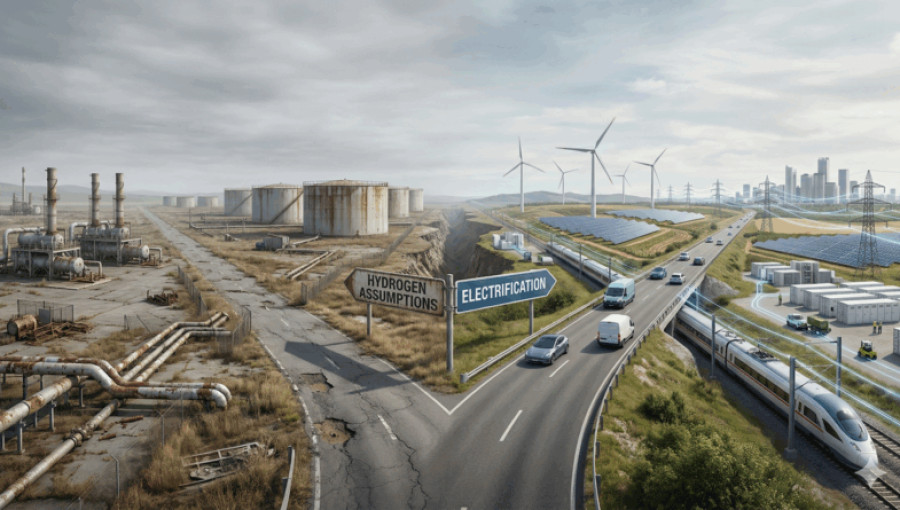
Germany’s long-standing commitment to hydrogen infrastructure, once a symbol of climate leadership, is increasingly viewed as a strategic misstep driven by early institutional inertia. While the nation’s hydrogen roadmap was born from a genuine desire to decarbonize when batteries and renewables were prohibitively expensive, it has evolved into a rigid policy framework that struggles to adapt to modern economic realities. As electrification and battery technology surpass hydrogen in efficiency and cost-effectiveness, Germany faces the challenge of unwinding massive infrastructure commitments to avoid passing billions in unnecessary costs to electricity consumers.
The roots of Germany’s hydrogen ambition trace back to the 1990s and early 2000s, a period when the path to a low-carbon future was far from certain. At the time, solar module and wind technology were in their infancy, and battery storage costs exceeded $1,000 per kWh. Hydrogen appeared to be a pragmatic solution, offering a way to store seasonal energy and utilize existing industrial expertise. Unlike the then-unproven potential of mass electrification, hydrogen felt like a natural evolution of the existing gas-based economy, leading to the creation of national roadmaps, specialized research institutes, and robust funding programs.
However, this early adoption created an institutional “black box” where hydrogen was no longer treated as a hypothesis to be tested, but as a foundational certainty. As the technology became embedded in regulatory frameworks and vocational training, it became increasingly difficult for policymakers to pivot. This momentum was further supported by incumbent industries, such as gas utilities and pipeline operators, who viewed hydrogen as a means to preserve the value of their physical assets in a world focused on reducing CO2 emission levels.
The economic disconnect became apparent in the 2010s as the inherent inefficiencies of the hydrogen supply chain were quantified. Green hydrogen production typically sees electrolysis efficiency at approximately 65%, with further losses of 10% to 30% during compression and transport. When converted back into electricity, another 40% to 60% of the energy is lost. Ultimately, delivering one unit of useful energy via hydrogen can require up to three units of upstream renewable electricity. Despite these physics-based hurdles, many international and domestic modeling scenarios continued to use aspirational production targets of $1 to $2 per kg as baseline assumptions, often ignoring the compounding costs of storage and delivery.
This optimistic modeling has led to the planning of a massive “hydrogen backbone” in Germany, designed to handle approximately 20 GW of capacity. Critics argue this infrastructure is significantly oversized, as it assumes hydrogen will be a broad energy carrier for heating and transport. In reality, the market is shifting; battery-electric trucks now achieve ranges of 600 kilometers with megawatt charging, making hydrogen-powered transport less competitive. The actual demand for hydrogen is likely to be restricted to niche industrial feedstocks, such as steel manufacturing and chemical refining, which do not require a continental pipeline network.
The financial risk of maintaining this course is substantial. Germany’s regulatory structure allows for the costs of these pipelines to be socialized across the broader electricity ratepayer base over several decades. This means that even if the infrastructure remains underutilized, consumers will bear the multibillion-euro burden. Analysts suggest that a courageous course correction is now required to separate moral intent from technical reality, ensuring that capital is directed toward more efficient decarbonization pathways like grid upgrades and direct electrification.