
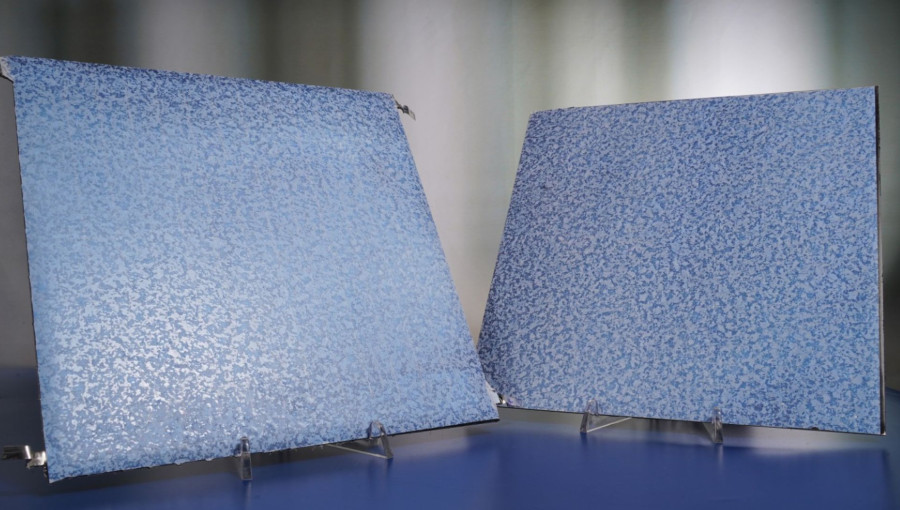
Fraunhofer Institute for Electron Beam and Plasma Technology has made significant advancements in solar technology with the Design-PV project, aiming to enhance the integration of photovoltaic (PV) modules into building facades. Utilizing roll-to-roll nanoimprint lithography, these solar modules are designed to blend seamlessly into modern architecture while achieving impressive efficiencies. This breakthrough not only addresses aesthetic concerns but also taps into previously unused vertical surfaces for energy production, which is crucial for Germany’s climate neutrality goals by 2045.
The Design-PV project’s innovative approach involves creating decorative films that allow PV modules to integrate harmoniously with building designs. The process, known as nanoimprint lithography (NIL), involves stamping intricate patterns onto a film and solidifying them with electron beams. This method enables the production of large, colorful films continuously, making manufacturing efficient and cost-effective. With a focus on urban sustainability, the project aims to facilitate the widespread adoption of building-integrated photovoltaics (BIPV), particularly in densely populated areas where land is limited.
Initial tests confirmed that these new PV modules are visually similar to traditional metal facade panels, delivering up to 80% of the efficiency of non-covered comparison modules. The project addresses long-standing aesthetic concerns that have hindered BIPV’s acceptance in architectural design. Dr. Steffen Günther, a project manager at Fraunhofer FEP, highlighted the successful integration of decorative finishes without compromising performance, paving the way for wider public acceptance of BIPV in urban settings.
A key challenge in this innovation is ensuring the strong adhesion of decorative films to various substrate materials. To enhance adhesion, researchers developed a plasma treatment process that significantly improves the bonding of the films on both PV glass modules and metal facade elements. This improvement is vital for ensuring the durability and longevity of the modules in real-world applications.
As Germany pushes towards its climate neutrality goal, this technology’s potential for harnessing untapped vertical surfaces for energy generation becomes increasingly important. The Design-PV project’s fusion of aesthetic appeal with functionality is set to enhance the acceptance of BIPV in future urban designs. Upcoming phases will include testing various colors, patterns, and durability in real-world environments, with findings to be presented at the Radtech Europe Conference in Warsaw, Poland, scheduled for October 27-29, 2025. The project is supported by the Federal Ministry for Economic Affairs and Energy, in collaboration with several industry partners.
https://interestingengineering.com/innovation/scientists-create-aesthetic-solar-facades