
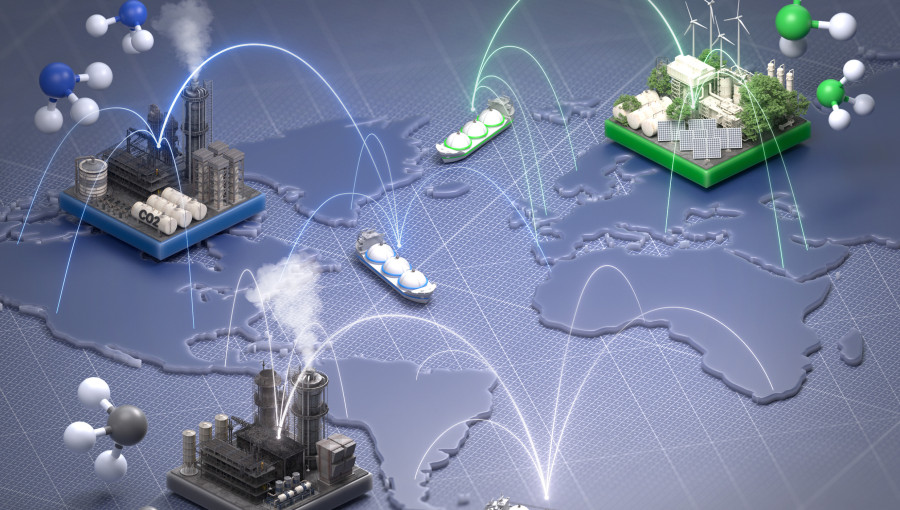
Researchers at the MIT Energy Initiative have developed a groundbreaking dataset to evaluate the economic and environmental impacts of global ammonia production. As a carbon-free energy carrier, ammonia is increasingly viewed as a vital alternative to traditional fuels, though its current manufacturing process has a significant carbon footprint. The study analyzes trade routes across 63 countries, comparing various production methods such as green and blue ammonia. These findings provide a roadmap for policymakers and industry leaders to balance CO2 emission reductions with the costs of transitioning to sustainable energy supply chains.
Ammonia is gaining international attention as a versatile hydrogen carrier and fuel source because it is energy-dense and carbon-free during combustion. While most ammonia is currently produced via the energy-intensive Haber-Bosch process—responsible for nearly 1.8 percent of global greenhouse gas emissions—cleaner alternatives are emerging. The new MIT study, published in Energy and Environmental Science, offers the most comprehensive look yet at how shifting to low-carbon production could reshape global energy balances and costs.
The research highlights significant trade-offs between cost and climate impact. Conventional “gray” ammonia, produced from natural gas without carbon capture, remains the cheapest option at approximately 48 cents per kilogram but results in 2.46 kilograms of CO2 emission per kilogram of fuel. In contrast, “blue” ammonia—which utilizes carbon capture and storage—can reduce emissions by 71 percent with a 23.2 percent increase in cost. The most sustainable option, “green” ammonia produced via renewable energy electrolysis, can slash emissions by 99.7 percent, though it currently requires a 46 percent price premium.
To create this dataset, the team synthesized information on trade flows, local energy prices, and financing environments for dozens of nations. The analysis identified China and the Middle East as potential leaders in the low-carbon ammonia market due to their competitive production costs and resource availability. For countries with abundant natural gas, blue ammonia pathways utilizing auto-thermal reforming (ATR) emerged as a particularly cost-effective decarbonization strategy compared to traditional steam methane reforming.
As nations like Japan and South Korea begin integrating ammonia into their national power grids, the need for standardized data has become critical. The MIT researchers noted that previous studies were often too fragmented, focusing only on specific regions or single technologies. This new global framework allows stakeholders to simulate various scenarios, helping governments set informed policies and companies choose the most efficient supply corridors. By quantifying the full lifecycle emissions from feedstock extraction to final delivery, the study provides a vital tool for the global transition toward a net-zero energy economy.