New Solar Device Converts Carbon Dioxide Into Liquid Fuel
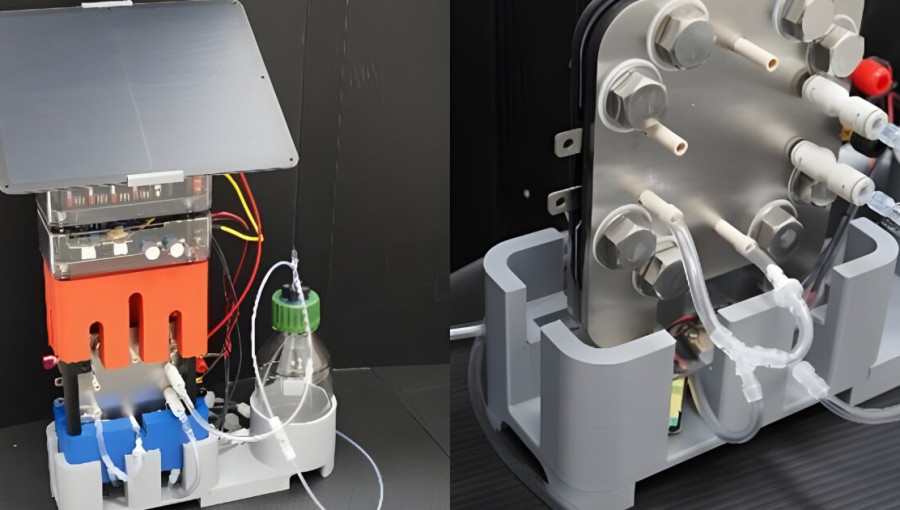
Researchers at Osaka Metropolitan University have developed an innovative artificial photosynthesis system capable of producing formic acid from carbon dioxide and water using solar energy. Unlike traditional setups that rely on complex battery-based hardware to stabilize fluctuating sunlight, this new device features a redesigned electrolyzer that self-regulates. By utilizing a solid-state electrolyte that adjusts its resistance based on temperature, the system effectively tracks solar power without external electronic middlemen. This breakthrough simplifies the production of solar fuel, offering a more efficient and autonomous method for converting renewable energy into storable liquid chemicals throughout the day.
The primary challenge in solar-fuel production is the inherent instability of sunlight. Conventional systems typically use photovoltaic panels to generate electricity, which is then managed by Maximum Power Point Tracking (MPPT) controllers and batteries to ensure the electrolyzer receives a steady power supply. This adds significant cost and technical complexity. By contrast, the Osaka team’s approach integrates the matching function directly into the electrolyzer. As sunlight intensity increases, the electrolyzer warms up, causing the ionic resistance of the solid-state electrolyte to drop. This allows more current to flow, naturally aligning the device with the available solar power.
To maintain consistent product concentration, the researchers incorporated a secondary control layer that monitors the electrical current. This system adjusts the flow rate of water and reactants in real time, ensuring that the formic acid output remains stable regardless of light intensity. By balancing the electrolyzer’s thermal behavior with precise flow control, the device functions as a "chemical MPPT" system. While the technology is currently a proof of concept requiring further durability testing, it represents a significant step toward simpler, more cost-effective distributed fuel production and carbon dioxide utilization.