
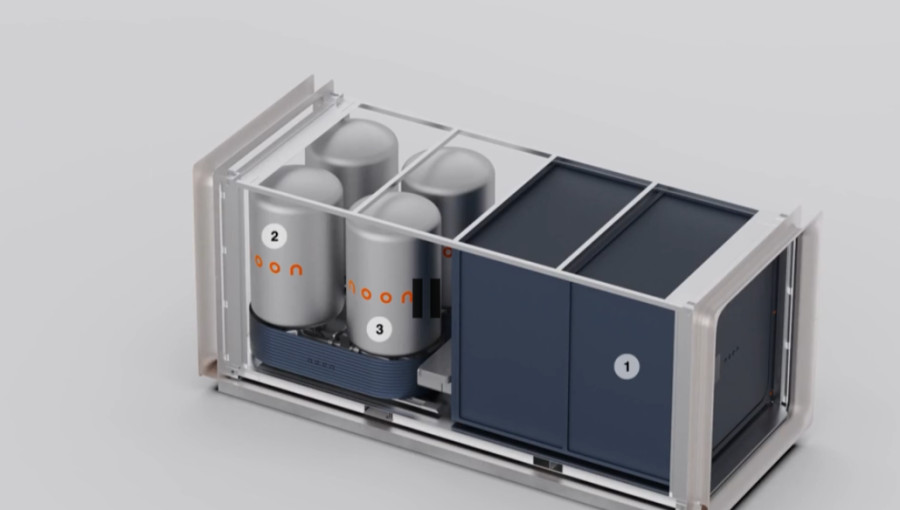
California-based Noon Energy has successfully demonstrated a revolutionary ultra-long-duration energy storage system capable of providing over 100 hours of continuous power. Using a modular, containerized design based on reversible solid oxide fuel cell technology, the pilot system marks a significant milestone in multi-day energy storage. This technology offers a compact, cost-effective alternative to traditional batteries, utilizing abundant materials and a domestic supply chain to meet the rising energy demands of industrial sectors and AI-driven data centers.
The pilot project represents the first fully containerized, modular ultra-long-duration energy storage (ultra-LDES) system to undergo thousands of hours of testing, with some operations reaching storage capacities of more than 200 hours. Developed to address the need for multi-day and even seasonal energy security, each unit delivers 100 kW of power. The system’s high energy density allows it to occupy a footprint significantly smaller than competing technologies; it is approximately 20 to 200 times smaller than pumped-hydro gravity storage or flow batteries and up to three times more compact than lithium-ion installations.
At the heart of the system is a power block featuring reversible solid oxide fuel cell technology. This setup converts electricity into stored chemical energy during the charging phase and reverses the process to provide power during discharge. The hardware includes a charge tank containing carbon-based storage media and a discharge tank to hold the media once it has been converted. This dual-tank approach allows the system to scale its energy capacity independently of its power capacity, meaning that adding more storage time simply requires larger or additional tanks of inexpensive, abundant materials.
This decoupling of power and energy makes the system increasingly cost-efficient as the storage duration grows, keeping the overall price of long-term storage nearly flat. Noon Energy also highlights the sustainability of its supply chain, noting that its technology requires only about 1% of the critical elements typically needed for lithium-ion batteries. This reduction in rare material reliance shields the company from the geopolitical and supply-chain risks often associated with battery production.
The technology is positioned as a vital partner for existing short-duration storage solutions. While lithium-ion systems are effective for two to ten hours of storage, Noon Energy’s battery offers up to 50 times that capacity. This combination is particularly relevant for the growing data center industry, which is projected to consume 12% of all US electricity by 2028. By pairing short-term and ultra-long-term storage, operators can ensure a steady, “firm” power supply that can withstand high-intensity demand spikes and long periods without renewable generation.
Following the success of this demonstration, which was supported by the California Energy Commission, Noon Energy is moving toward larger applications. CEO and co-founder Chris Graves confirmed that the company has already constructed a commercial-scale system. This larger iteration is expected to be commissioned soon, targeting hyperscale data centers and other industrial sectors facing rapid load growth.