Report Urges Oahu To Prioritize Solar Over New Plants
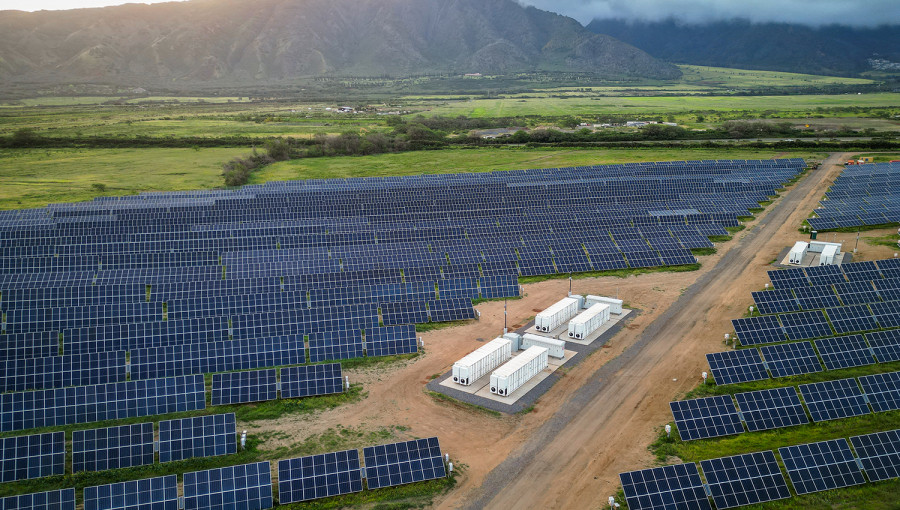
A new report from the University of Hawaiʻi Economic Research Organization (UHERO) argues that Oʻahu should prioritize the expansion of solar farms and battery storage over the construction of new power plants to reach the state's 100% renewable energy goal. Researchers suggest that by reducing regulatory hurdles and development costs, the island could save ratepayers billions of dollars by 2050. While the authors acknowledge a calculation error regarding solar costs, they maintain that solar-plus-storage remains the most viable path forward, despite pushback from Hawaiian Electric Co. regarding land availability and project expenses.
The study, authored by Michael Roberts, Ethan Hartley, and Matthias Fripp, contends that Oʻahu does not require new fuel-burning power plants, regardless of whether they are proposed by Hawaiian Electric Co. (HECO) or JERA. Currently, HECO is pursuing plans to rebuild a power plant for renewable fuel, while JERA has proposed a natural gas facility that would eventually transition to renewables. The UHERO report suggests that if Hawaiʻi could align its solar development costs with mainland standards by lowering "soft costs" and regulatory burdens, customers could save $3.4 billion between 2027 and 2050.
HECO has challenged these findings, arguing that the report fails to account for the true costs of labor, shipping, land, and materials in Hawaiʻi. Jim Kelly, a spokesperson for HECO, stated that the report’s reliance on solar-plus-battery as the universal cheapest option does not reflect the realities of recent projects. Furthermore, the utility company raised concerns about the feasibility of the report's land-use projections, noting that the required build-out of 6,600 megawatts of solar capacity would necessitate covering roughly 31,500 acres, or 60% of the island's developable land.
Addressing the challenge of finding space for large-scale photovoltaic arrays, the report identifies over 27,500 acres across 334 sites, suggesting that easing land-use restrictions could expand this to 49,000 acres. While the authors admit that large-scale deployment is not an easy task, they maintain that the land is available. Although the researchers issued a correction regarding a specific solar cost calculation following feedback from HECO, they stand by their primary conclusion that prioritizing solar and storage infrastructure is the most effective strategy for the state’s energy transition.