
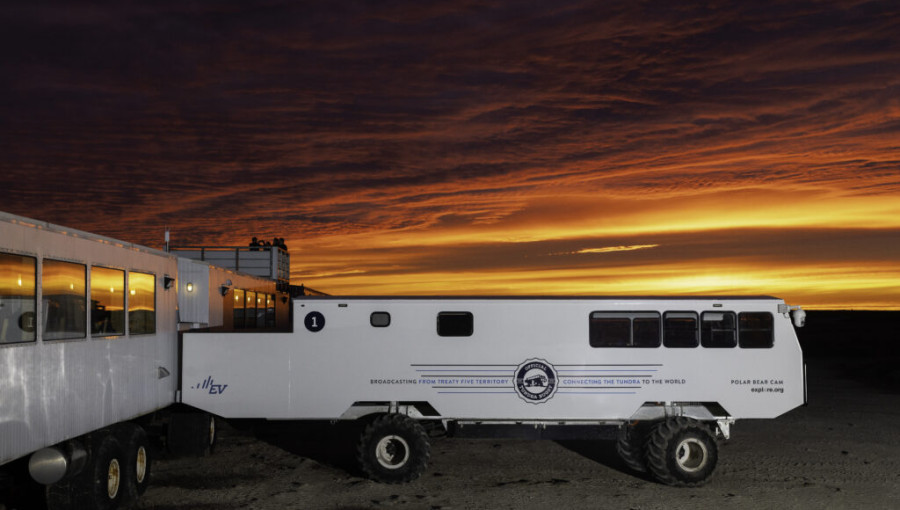
Scientists and conservationists monitoring the annual polar bear gathering in Churchill, Canada, have introduced a groundbreaking tool for their work: a custom-built, all-electric Tundra Buggy. This zero-emission vehicle enables researchers to study the animals up close without the noise and pollution of traditional diesel engines, representing a major advancement in sustainable wildlife observation. The silent-running buggy, developed through a collaboration between conservation groups and a sustainable tourism company, is engineered to minimize disturbance to the bears while withstanding the harsh subarctic conditions of Hudson Bay.
Every autumn, polar bears congregate on the shores of Hudson Bay near Churchill, Manitoba, a unique natural spectacle. The animals gather in this specific area as they wait for the sea ice to form, which will allow them to venture out and hunt for seals, their primary food source. This annual event offers a rare opportunity for scientists to observe the bears, which are typically solitary creatures. Researchers on site this year have noted that while the bears appear healthy, the weather has been unseasonably warm.
In a significant upgrade for research and conservation efforts, a two-decade-old diesel vehicle has been replaced by the new EV Tundra Buggy One. Its silent electric motor allows for observation without startling the animals, providing a more authentic look at their natural behaviors. Furthermore, its zero-emission design ensures that the research itself does not contribute to the CO2 emissions that are accelerating climate change and the loss of the sea ice habitat crucial to the polar bears’ survival.
The innovative vehicle is the result of a partnership between Polar Bears International, the sustainable tourism company Frontiers North Adventures, and was constructed by Northern Noble Ltd. It was designed from the ground up as a bespoke vehicle capable of operating in extreme conditions, including temperatures as low as -30°C. Functioning as a mobile research station and broadcast studio, the buggy has already been put to use by scientists since its arrival in the region.
Beyond its research applications, the EV Tundra Buggy One serves as a powerful tool for global outreach. It facilitates live webcams and interactive chats with scientists, allowing people worldwide to witness the polar bear gathering. This initiative aims to foster a deeper connection to the Arctic ecosystem and highlight the importance of conservation, demonstrating that if clean energy technology can succeed in the subarctic, it can be implemented in communities everywhere.