
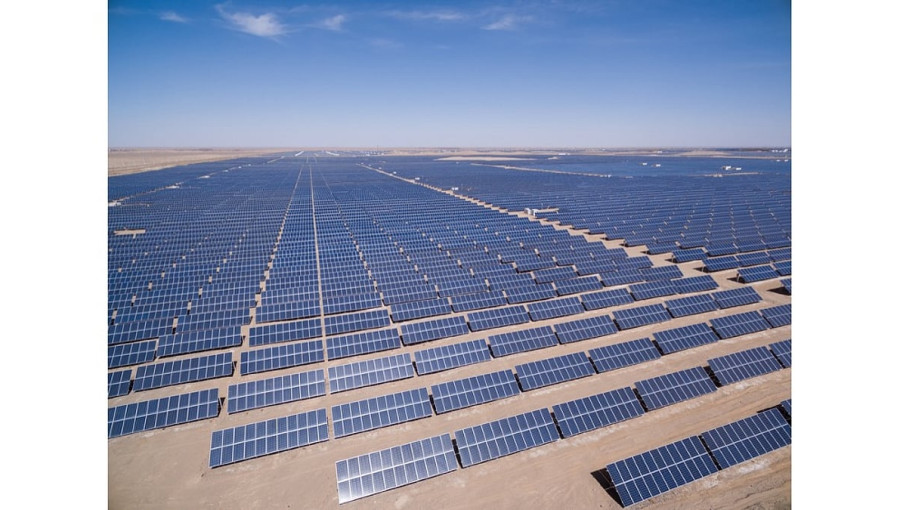
Solar energy has emerged as the most affordable power source globally, priced at just £0.02 ($0.027) per kWh in regions with abundant sunlight, according to a recent analysis from the University of Surrey’s Advanced Technology Institute. This development positions solar energy as a cheaper alternative compared to fossil fuels like coal and gas. The study attributes the cost reduction to advancements in battery technology, enabling solar energy combined with storage to compete effectively with traditional energy sources.
The report highlights how the steep decline in lithium-ion battery prices, which have decreased by 89% since 2010, has positioned solar-plus-storage systems as viable alternatives to gas plants. As a result, the conversation is shifting from the feasibility of renewable energy to the speed of deployment, as noted by the study, which references Lazard’s findings indicating that utility-scale solar PV’s levelized cost of energy is below that of gas, coal, and peaking power. Emphasizing solar’s growing influence, an Ember report predicts that solar energy sources surpassed coal in global power generation for the first time in the first half of 2025.
The study further asserts that favorable policies and technological advancements enable solar energy to be the most viable and scalable solution for decarbonization efforts worldwide by 2025. China’s leading role in photovoltaic manufacturing has significantly reduced production costs, while supportive policies in regions such as the United States, European Union, and India stabilize investments. Solar power not only helps mitigate reliance on volatile fossil fuel markets but also fosters job creation, enhancing energy access, especially for underserved populations in Sub-Saharan Africa and South Asia.
Competitive procurement strategies like renewable energy auctions and long-term power purchase agreements have also contributed to lowering costs. The authors note that the accumulation of experience with widespread solar deployment has diminished installation and maintenance costs. Professor S. Ravi P. Silva from the University of Surrey remarked on the technology’s credibility, stating that solar energy is now a fundamental part of a resilient low-carbon energy infrastructure, even in regions far from the equator.
However, the study identifies significant challenges that must be addressed for solar energy to contribute effectively to global net-zero emission targets. Integrating large-scale energy storage systems is crucial to accommodate the rising volume of solar energy generation, which must be paired with upgrades to electricity grids designed for fossil fuel-based systems. Continued research into innovative solar technologies, such as tandem and recyclable panels, is essential for enhancing efficiency and sustainability. Dr. Ehsan Rezaee, a research fellow, emphasized the need for smart grids and improved regional connections to stabilize power systems as renewable energy usage expands. The findings from the University of Surrey are set to be published in the Energy & Environmental Materials journal.