Solid-State Battery Patent Filings Surpass Lithium-Ion Technology In 2024
South Korea leads global solid-state patent activity as lithium-ion filings experience a second consecutive year of decline.
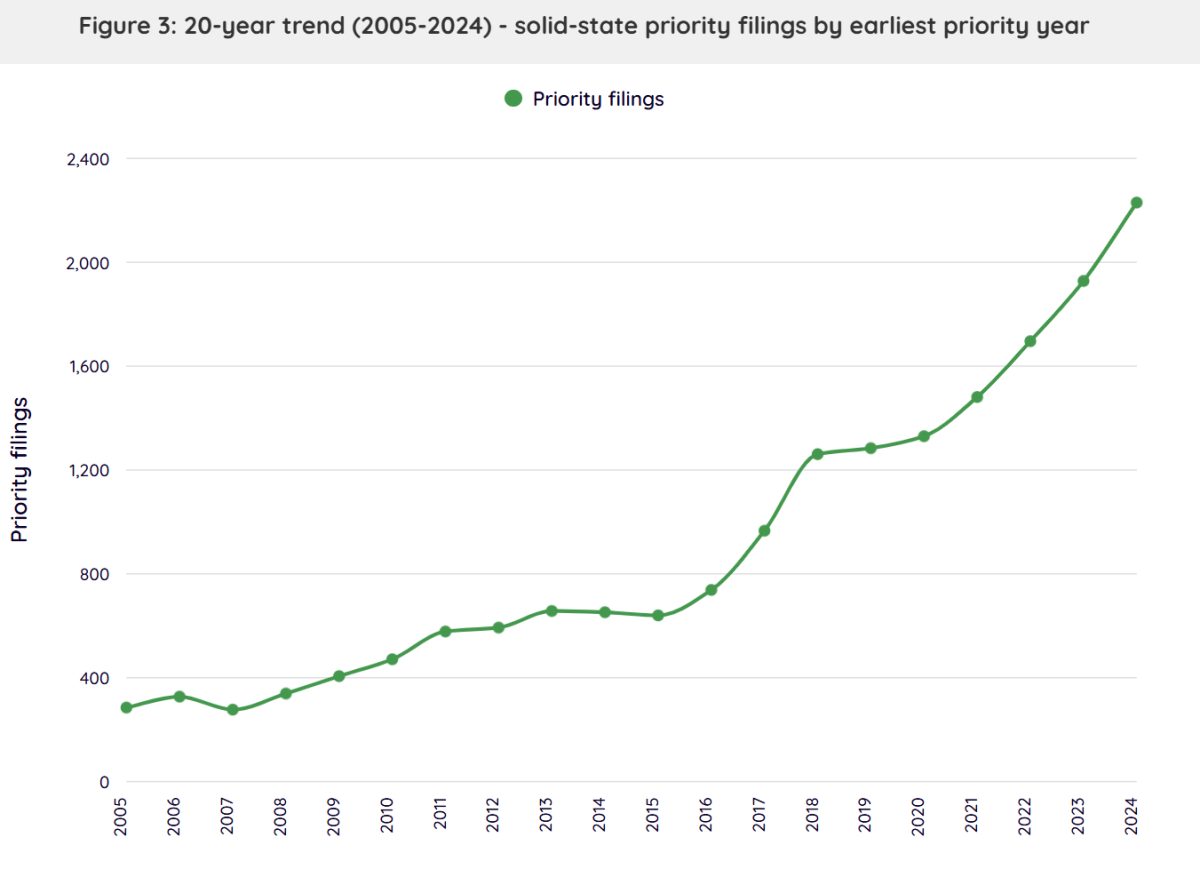
Global patent filings for solid-state batteries reached a record 2,230 in 2024, representing a 16% increase over the previous year. According to the sixth annual Inside Green Innovation: Progress Report from intellectual property firm Appleyard Lees, this surge allowed solid-state technology to overtake lithium-ion battery patents, which fell by nearly 15% to 2,092 filings during the same period.
South Korea emerged as the leader in solid-state filings with 873 applications, surpassing Japan, which recorded 605. This shift was largely attributed to a significant increase in activity from Samsung SDI, which nearly doubled its filings to 325. In contrast, Toyota recorded 144 filings. China ranked third globally with 217 filings, more than doubling its output since 2022, while Europe reached a record 177 filings.
Chris Mason, a partner at Appleyard Lees, noted that solid-state electrolytes demonstrated the strongest growth within the data. He suggested that the decline in lithium-ion patent activity reflects the maturation and commercialization of supply chains, particularly regarding lithium iron phosphate (LFP) cells used in stationary energy storage. Patent volumes typically serve as a lagging indicator of research and development expenditure.
The report also highlighted trends in other energy storage technologies. Sodium-ion patent activity decreased by 29% to 392 filings following a record year in 2023, though European organizations achieved a record 76 filings in this sector. Meanwhile, flow battery patent filings have remained on a plateau since 2016 despite the increasing deployment of grid-scale storage solutions.
Beyond battery technologies, the report examined the fusion energy sector, describing it as an emerging platform technology. Research in this field is multidisciplinary, involving advancements in plasma physics, cryogenics, and superconducting materials. These innovations are increasingly generating intellectual property with potential applications in sectors such as semiconductors, healthcare, aerospace, and energy infrastructure.