
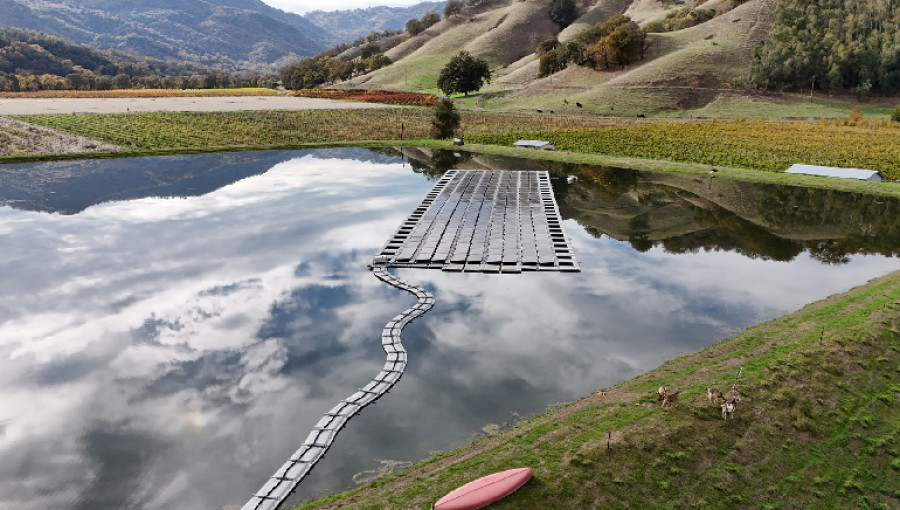
A historic family vineyard in Mendocino County, California, has achieved 100% energy independence by installing an innovative floating solar system on one of its irrigation ponds. The project allows Nelson Family Vineyards to power its entire 1,800-acre operation, including its winery and on-site residences, without sacrificing valuable farmland. The system is projected to save the business approximately $90,000 a year. Furthermore, the installation will serve as a living laboratory for University of California, Davis, researchers studying the environmental impacts and potential agricultural benefits of floating photovoltaics.
Nelson Family Vineyards, a 74-year-old family-run farm, is now operating entirely on clean energy. The newly commissioned floating photovoltaic (FPV) system, situated on an irrigation pond, works in tandem with an existing rooftop solar array. Together, they are expected to produce approximately 200,000 kWh of electricity each year, sufficient to meet the demands of the winery, agricultural pumps, a tasting room, a shop, and twelve homes located on the property. This innovative approach ensures that no agricultural land is taken out of production for energy generation.
The move toward renewable energy is expected to yield substantial financial benefits. Tyler Nelson, the owner, highlighted the immediate impact of energy independence in an era of rising electricity costs. “With the cost of grid electricity rising so sharply, becoming energy independent will have a major and immediate impact on our operation,” Nelson stated, noting the significant annual savings. He also emphasized the project’s key land-use advantage: “Because the system floats on a pond, it does not take a single acre of land out of production.”
Beyond its energy production, the installation is a pioneering field site for an ecological study led by scientists from the UC Davis Wild Energy Center. The research will investigate how FPV technology affects water quality, aquatic life, and local biodiversity within an agricultural setting. A primary focus will be to assess if the shade cast by the solar panels can suppress the growth of invasive zooplankton and aquatic weeds that frequently clog the vineyard’s drip irrigation filters. This could potentially reduce labor-intensive maintenance and the need for chemical treatments.
The system was designed and installed by Noria Energy. Ron Stimmel, President of Noria Energy, described the project as a demonstration of how underutilized water surfaces can be transformed into productive power sources. He noted that the technology enables growers to improve both the sustainability and efficiency of their operations while keeping all available farmland dedicated to agriculture.