
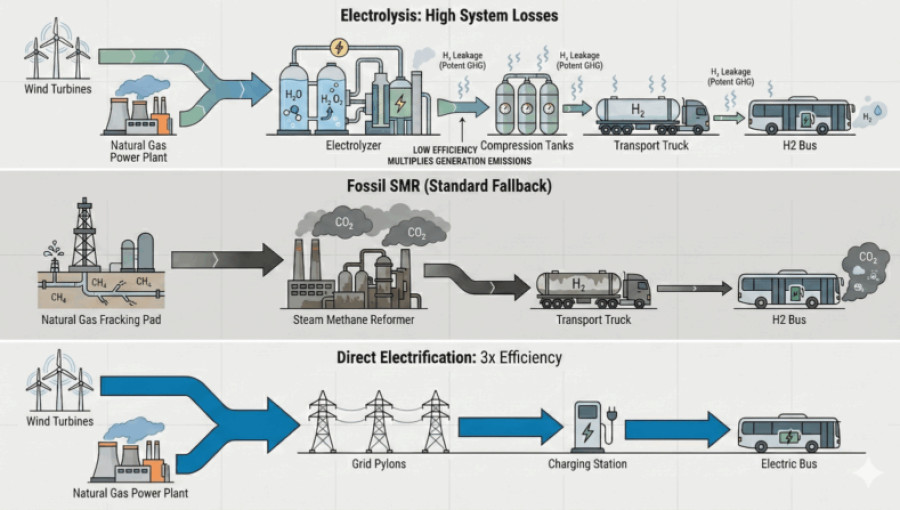
Recent analyses of hydrogen-powered public transit projects reveal a significant discrepancy between their “zero-emission” branding and their actual climate impact. When the entire fuel lifecycle is accounted for—from production and transport to leakage—hydrogen buses and ferries often generate CO2 emissions comparable to, or even exceeding, their diesel counterparts. This counterintuitive result stems from energy-intensive supply chains and the often-overlooked warming effect of hydrogen leaks, challenging the perception of hydrogen as a clean transportation solution in many real-world applications.
The foundational issue in evaluating hydrogen transportation has been an overemphasis on tailpipe emissions. Because hydrogen fuel cell vehicles emit only water vapor, they have been widely classified alongside battery-electric vehicles as “zero-emission.” This framing, adopted in government grants and public policy, overlooks the substantial upstream energy and emissions required to produce, process, and deliver the hydrogen fuel. Unlike electricity, hydrogen is not a primary energy source and must be manufactured, a process that invariably has an environmental footprint. This narrow focus has allowed high-emission fuel systems to be marketed as climate-friendly solutions.
The carbon intensity of hydrogen fuel is highly dependent on its production method. When produced via electrolysis, the process requires between 50 to 55 kWh of electricity per kilogram of hydrogen. If this electricity comes from a grid dominated by natural gas or coal, the resulting CO2 emissions can make a hydrogen bus several times more polluting than a modern diesel bus on a comprehensive “well-to-wheel” basis. Projects that fall back on “gray hydrogen,” produced from natural gas via steam methane reforming, face even worse outcomes. This common industrial method releases so much CO2 that buses running on it regularly exceed the emissions of the diesel fleets they are intended to replace.
A critical, and often ignored, factor is hydrogen leakage. As the smallest molecule, hydrogen is notoriously difficult to contain and can escape from seals, valves, and joints throughout the supply chain. Recent atmospheric science has established that hydrogen is a potent indirect greenhouse gas, with a global warming potential many times that of carbon dioxide over a 20-year period. It contributes to warming by extending the atmospheric lifetime of methane. Even a conservative leakage rate of a few percent can significantly increase the total climate impact of a hydrogen transit system, often tipping the scales to make it worse than diesel.
Multiple real-world projects illustrate this recurring pattern. In Whistler, British Columbia, hydrogen for a bus fleet was produced with low-carbon hydropower in Quebec but had to be transported approximately 4,500 kilometers by diesel trucks. The emissions from this long-haul transport effectively negated the fuel’s climate benefits. Similarly, a proposal in Winnipeg, Canada, was canceled after its plan shifted from using local hydropower for electrolysis to reforming methanol, a change that would have tripled the emissions compared to diesel buses.
The trend is also evident in Europe. A hydrogen ferry in Norway, the MF Hydra, was supplied with hydrogen trucked over 1,300 kilometers from Germany. An analysis of its entire “well-to-wake” emissions, including production and transport, showed it was roughly twice as polluting as the diesel ferry it replaced. The hydrogen bus project in Dijon, France, followed the same trajectory, where reliance on a centralized production and distribution network resulted in emissions comparable to or higher than diesel once the full supply chain was considered.
These outcomes are frequently obscured by studies that rely on overly optimistic assumptions, such as short delivery distances, dedicated renewable energy sources, and negligible leakage rates. In practice, hydrogen is rarely produced where it is used, often relies on the existing grid mix, and is prone to leakage. In contrast, battery-electric buses can charge directly from an increasingly green grid at depots, avoiding the complex and energy-intensive logistical challenges that consistently undermine the environmental case for hydrogen in public transportation.