Revolutionary Iron Air Battery Powers Dutch Grid
A novel iron-air battery technology has achieved a major milestone by successfully connecting to a public power grid for the first time in the Netherlands. Developed by the Dutch startup Ore Energy, the system went online at Delft University of Technology, demonstrating a low-cost, long-duration energy storage solution. By utilizing a reversible rusting process with abundant materials like iron and air, this technology offers a promising alternative to conventional lithium-ion batteries, potentially transforming how energy from intermittent renewable sources like solar and wind is stored and utilized on a grid scale.
This groundbreaking grid connection marks a critical step in proving the real-world viability of iron-air battery systems. The technology operates on a simple yet effective principle: it uses electricity to convert iron oxide, or rust, back into pure iron. When power is needed, the iron is exposed to air, and the subsequent oxidation process releases the stored energy. Unlike standard lithium-ion batteries, which typically provide four to six hours of storage, this system is designed for multi-day flexibility, capable of holding a charge for over 100 hours.
The development directly addresses a core challenge of renewable energy integration known as the "duck curve." Solar panels generate abundant electricity during sunny afternoons, but production ceases in the evening just as household energy demand peaks. This intermittency forces grid operators to rely on expensive and polluting natural gas plants to fill the gap. Long-duration storage systems like the iron-air battery can absorb excess solar power during the day and dispatch it for hours or even days, providing a stable and clean power supply.
A key advantage of this technology is its dramatically lower cost. The primary components are iron, one of the most mined metals on Earth at roughly $100 per ton, and air, which is free. This results in a component cost of approximately $20 per kilowatt-hour, a stark contrast to the $300 to $400 per kilowatt-hour for the lithium iron phosphate systems that currently dominate the market. Furthermore, the battery’s water-based electrolyte is non-flammable, making it significantly safer for large-scale deployment near communities compared to the fire risk associated with lithium-ion chemistry.
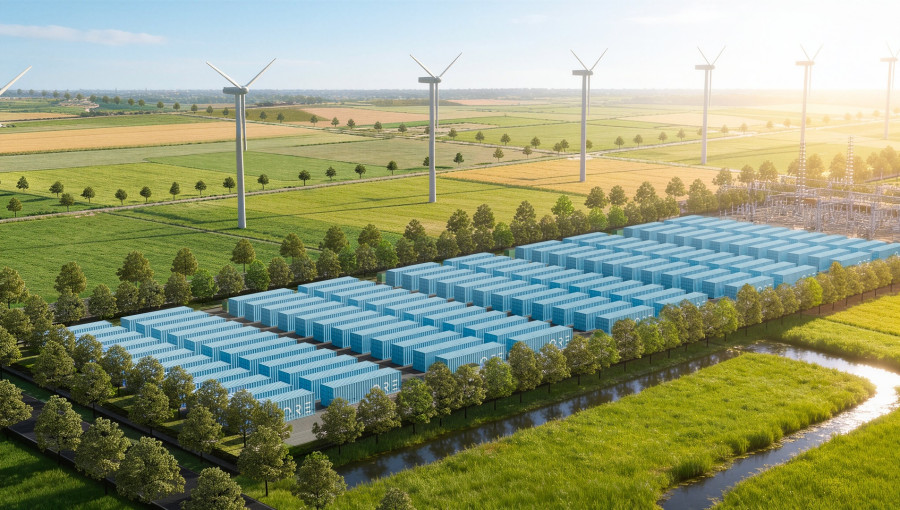
The successful demonstration in the Netherlands is expected to accelerate the adoption of this technology worldwide. In the United States, another company, Form Energy, is already planning several iron-air battery projects scheduled for completion in 2025. As these systems, often housed in standard shipping containers storing multiple megawatt-hours of energy, become more common, they could play a crucial role in stabilizing power grids, reducing reliance on fossil fuels, and ultimately lowering electricity costs for consumers.