
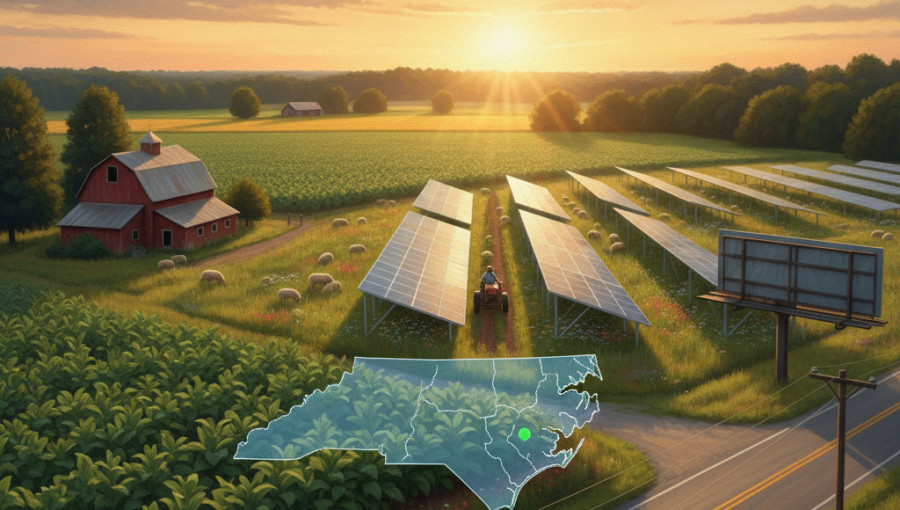
A recent analysis by the North Carolina Sustainable Energy Association has found that solar energy installations occupy a negligible fraction of the state’s agricultural land, despite rising political opposition. The report clarifies that solar fields cover less than 0.33% of North Carolina’s 4.45 million hectares of farmland. While critics argue that solar development endangers the rural way of life, the data suggests these projects offer vital economic lifelines to farmers. Through property tax contributions and stable lease income, solar development is supporting rural economies rather than displacing the state’s massive agricultural industry.
The debate over land use has intensified in North Carolina, a state that ranks among the top five for solar deployment while remaining an agricultural powerhouse. Opponents of renewable energy, including state legislators and various community groups, have frequently claimed that massive solar installations are overrunning the countryside. This sentiment recently culminated in the “Farmland Protection Act,” a piece of legislation aimed at curbing the growth of the industry. However, the latest findings from the North Carolina Sustainable Energy Association (NCSEA) suggest that the actual footprint of solar is minimal.
Drawing on data from the U.S. Geological Survey and satellite imagery, the NCSEA report confirms that solar projects with a capacity of one megawatt or more account for only 0.28% of the state’s agricultural acreage. This figure has remained consistent since the previous study in 2022. Despite the low percentage, the perception of a “solar invasion” persists, largely because developers tend to place solar modules near existing power lines and substations. This makes the installations highly visible from main roads, creating an illusion of widespread land conversion.
The political pressure remains significant. House Bill 729, sponsored by Republican Representative Jimmy Dixon, originally sought a total ban on large-scale solar on agricultural land. While that provision was removed, the current version of the bill aims to eliminate county property tax incentives for solar developers. Industry experts warn that removing these breaks could effectively halt many future projects. The bill has already moved through several House committees with support from the state Farm Bureau, reflecting a deep-seated skepticism within the $111 billion agricultural sector.
In reality, the economic data presents a different story for rural communities. Counties often generate significantly higher property tax revenue from land hosting solar panels compared to traditional farming. Furthermore, farmers who lease a portion of their land for solar arrays can earn between $750 and $1,400 per 0.4 hectares annually. This guaranteed income acts as a hedge against the volatile nature of crop prices and livestock markets. In Halifax County, where solar occupies roughly 1% of farmland, local officials recently rejected a proposed ban after residents testified that solar leases were the only thing saving their family farms from foreclosure.
Looking forward, some advocates see a middle ground in agrivoltaic systems. These setups allow for the dual use of land, where crops are grown or livestock is grazed beneath and around solar modules. While this approach could theoretically satisfy both energy and agricultural needs, many established farmers remain unconvinced. Decades of conflict over environmental regulations and CO2 emission standards have left a legacy of distrust, making it difficult for data-driven reports to change minds in a community that often prioritizes tradition and visual landscape over statistical analysis.