
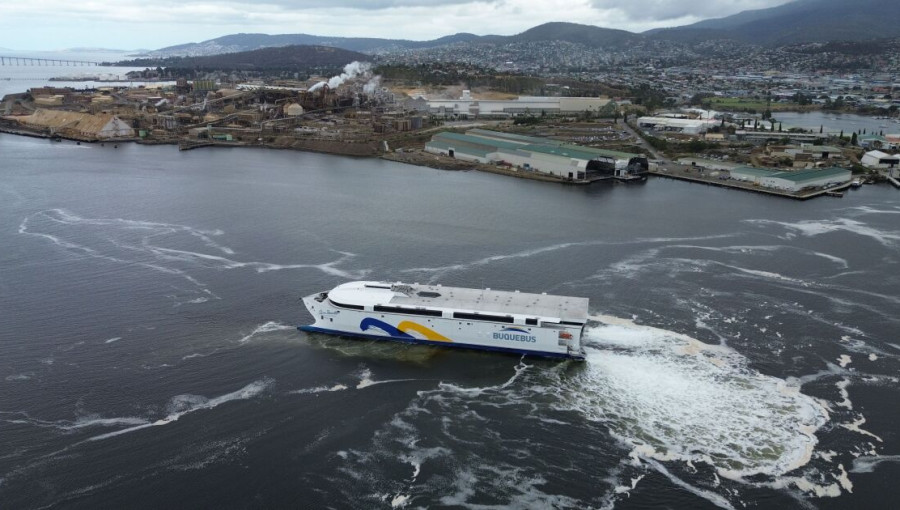
The world’s largest battery-electric ship, Hull 096, has officially commenced harbor trials on the River Derwent in Tasmania. Developed by Incat Tasmania for South American operator Buquebus, the 130-meter vessel marks a historic milestone as the first ship of its scale to operate entirely on battery-electric propulsion. Featuring a massive 40 MWh battery system and the capacity to transport over 2,100 passengers, the ferry represents a significant shift toward zero-emission maritime transport, transitioning from an ambitious design concept to a functional reality during its recent maneuvers on the water.
The vessel’s first movements earlier this month were characterized by an unusual silence, lacking the traditional engine roar and exhaust plumes associated with large-scale shipping. Instead, the 130-meter ferry utilized its quiet waterjets to navigate the harbor under its own power for the first time. This testing phase follows years of complex engineering and serves as a critical validation of the ship’s integrated systems, proving that a vessel of this magnitude can rely solely on electricity.
Originally envisioned as a vessel powered by liquefied natural gas (LNG), the project underwent a radical transformation in 2023. As battery technology improved and global fuel prices became increasingly volatile, Incat and Buquebus decided to pivot to a fully electric design. This decision was a bold gamble, as there was no existing precedent for a battery-electric ship of this size. Incat Chairman Robert Clifford described the move not as a minor improvement, but as a deliberate leap toward the future of commercial maritime travel.
At the heart of Hull 096 is an unprecedented energy storage system. The ship carries more than 250 tonnes of batteries, providing over 40 MWh of capacity—roughly four times the size of any previous maritime battery installation. This power drives eight electric waterjets, allowing the ferry to carry 2,100 passengers and more than 220 vehicles simultaneously. These specifications solidify its position as one of the largest electric vehicles ever constructed.
The journey toward these trials began with the ship’s launch in May 2025, followed by initial stationary power tests in December 2025. During those early stages, engineers focused on validating the e-motor trials and ensuring the massive battery arrays could communicate effectively with the propulsion system. Clifford noted that those successful tests were a turning point, confirming that the intricate design integration was sound.
The current harbor trials on the River Derwent are designed to push the vessel further, testing real-world maneuverability, propulsion response, and control systems. Once these harbor assessments are complete, the ship will move into open-sea trials before its final delivery to South America. These tests represent a shift from hypothetical green shipping to a tangible reality, potentially setting a new standard for the global ferry industry in terms of both environmental impact and operational noise.