
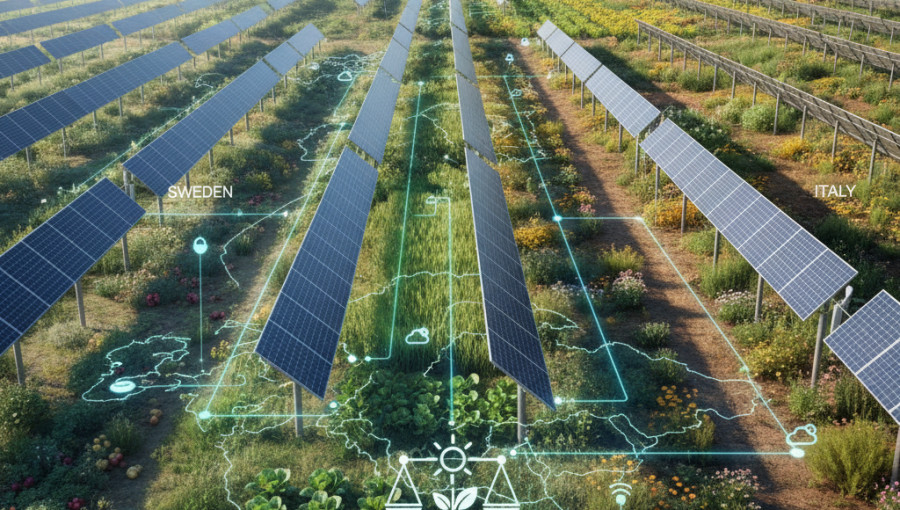
Researchers at Mälardalen University in Sweden have developed a sophisticated methodology to optimize agrivoltaic systems across Europe, focusing on maximizing the Land Equivalent Ratio (LER). By analyzing the interplay between local climates, crop varieties, and regional regulations, the study identifies row spacing as the most critical factor in balancing energy production and agricultural yield. The findings suggest that a row pitch of 5 to 10 meters offers the ideal compromise for land-use efficiency, providing a blueprint for developers to navigate the complex trade-offs between food and energy security.
The research highlights that agrivoltaic performance is deeply context-dependent, meaning standardized solutions are often ineffective. According to lead author Sebastian Zainali, system designs must be meticulously tailored to specific sites. Shade-tolerant crops allow for denser solar module configurations, whereas light-sensitive varieties require wider spacing. Furthermore, the optimal geometry of a facility—including its orientation and height—shifts depending on whether the primary goal is to prioritize water conservation, electricity generation, or maximum food output.
To test their methodology, the scientists utilized the Agri-OptiCE® platform to simulate performance at three distinct locations: Kärrbo Prästgård in Sweden, Jeggeleben in Germany, and Piacenza in Italy. This platform integrates solar shading models with bifacial PV performance and crop growth data. By employing a multi-objective genetic algorithm, the team was able to identify designs that satisfied both environmental constraints and production targets across different climatic zones.
The study also underscores the significant role of national regulations in shaping project viability. For instance, Sweden limits land occupation to 10% for subsidy eligibility, while Germany mandates that crop yields remain above 66% of traditional levels. Italy imposes even more specific criteria, requiring solar panel heights to exceed 2.1 meters and limiting land use to 30%. These varying legal frameworks often dictate the physical limits of a project more strictly than the biological needs of the crops themselves.
Technical analysis revealed that row pitch is the dominant design parameter, significantly affecting shading patterns and annual yield stability. While narrow spacing boosts energy output, it often leads to excessive shading that stunts crop growth. Conversely, spacing wider than 10 meters reduces land-use efficiency by leaving too much ground underutilized. The researchers found that a 5-to-10-meter pitch generally maintains the necessary balance to keep LER high while meeting most European regulatory thresholds.
Ultimately, the researchers concluded that flexible, evidence-based policies are essential for the growth of the sector. Overly rigid constraints can inadvertently disqualify efficient designs that would otherwise thrive in specific local conditions. The full findings, which provide a quantitative guide for future agrivoltaic deployment, have been published in the Journal of Cleaner Production.