
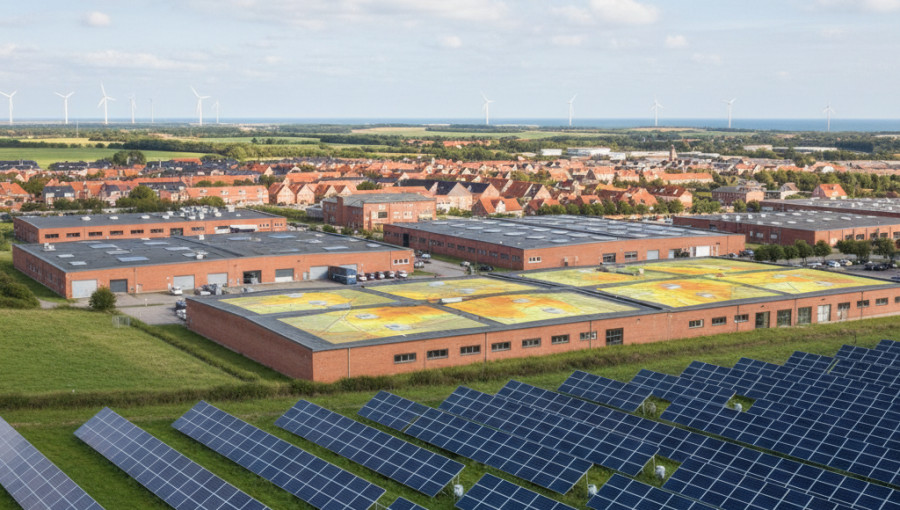
Denmark reached a historic milestone in its renewable energy transition by installing a record-breaking 1.55 GW of solar capacity in 2025. This surge, primarily driven by large-scale ground-mounted utility projects, brought the nation’s cumulative solar capacity to approximately 6.3 GW. While the utility sector saw exponential growth compared to the previous year, the rooftop segment experienced a slight slowdown. Despite this, industry experts emphasize a massive untapped potential for building-mounted solar, suggesting that regulatory improvements in energy sharing could further accelerate the country’s green energy objectives.
According to data from the Danish solar association, Dansk Solcelleforening, the 1,548 MW commissioned last year represents the most successful period for solar expansion in Denmark’s history. This performance significantly outpaces the 1 GW added in 2022 and the 545 MW installed during 2024. The current total capacity of 6.3 GW is now sufficient to meet the annual electricity demands of roughly 1.25 million Danish households.
The primary catalyst for this growth was the utility-scale sector, which accounted for 1.34 GW of the new installations. This marks a substantial increase from the 330 MW recorded in 2024. Among the most notable developments was a 215 MW solar project located in Lolland, southern Denmark. Developed by European Energy, it stands as the nation’s second-largest solar installation. The company also completed the 148 MW Glejbjerg solar park, which shares grid infrastructure with the 175 MW Holsted Solar Park finalized in late 2024.
In contrast to the booming utility sector, the rooftop solar market saw a moderate decline. Total building-mounted installations reached 202 MW in 2025, down from 217.5 MW in 2024 and 242 MW in 2023. This total included 61 MW from residential projects and 141 MW from the commercial and industrial sectors, alongside 6.3 MW of utility-scale rooftop arrays.
Birgitte Eskildsen of Dansk Solcelleforening highlighted that there is still significant room for expansion, particularly on large rooftops exceeding 500 square meters. She noted that these surfaces alone could potentially host an additional 10 GW of solar power capacity—more than double Denmark’s current total. To unlock this potential, the association advocates for more attractive energy-sharing regulations for both public and commercial buildings. To assist in this transition, the Danish Energy Agency has already implemented a digital tool to help property owners evaluate the solar potential and average exposure of their roof surfaces.