
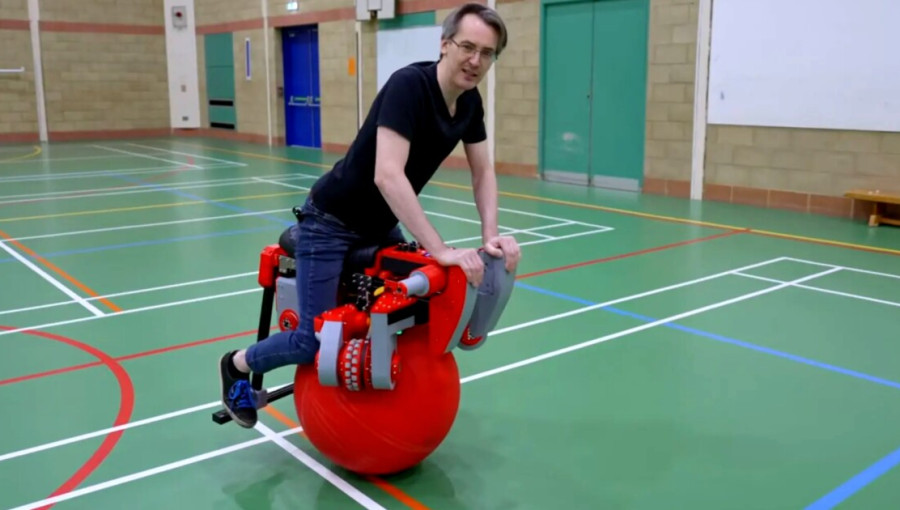
British inventor James Bruton has unveiled his latest engineering feat: a self-balancing electric motorcycle that operates on a single spherical wheel. Building on his previous dual-ball design, this new prototype utilizes three powerful motors and a complex control system to maintain equilibrium while carrying a rider. Despite significant challenges regarding steering and static electricity interference, the project showcases an innovative approach to omnidirectional mobility. The open-source development represents a bold step in experimental personal transportation, blending 3D-printing technology with advanced robotics algorithms to achieve a unique balancing act.
The machine’s core is a large red sphere driven by a trio of custom-built omni-wheels. Each wheel is powered by a motor capable of reaching 2 kW. Unlike traditional balancing robots that typically use horizontal layouts, Bruton positioned these wheels vertically. This specific orientation prevents the 216 passive rollers—constructed with custom aluminum hubs and TPU tires—from jamming during high-speed operation. A sophisticated PID controller processes data from an onboard IMU to calculate motor adjustments in real-time, ensuring the vehicle remains upright in both the longitudinal and lateral planes.
The structural integrity of the bike relies on 40 x 40 mm aluminum extrusion profiles complemented by various 3D-printed structural components. To power the high-torque motors, the system utilizes six LiPo battery packs wired in series to provide a 50-volt output. Movement is dictated by precise trigonometric ratios; for instance, when traveling in a straight line, the two wheels angled at 60 degrees to the direction of travel operate at half the speed of the primary forward wheel to maintain a consistent trajectory.
Transitioning from a two-ball configuration to a single sphere introduced significant navigation hurdles. Without a second sphere to provide counter-rotation for steering, the initial prototype proved difficult to turn. To address this, Bruton implemented a temporary aerodynamic solution: a large foam fin attached to the frame. This control surface uses air resistance to bias the bike’s direction while in motion. Additionally, the friction between the rubber rollers and the plastic ball generates substantial static electricity, which has been known to scramble the electronics and cause unexpected system shutdowns.
While the project remains in the experimental phase, Bruton has released all CAD files and source code as open-source material, encouraging further development from the global engineering community. Future iterations are expected to tackle the steering dilemma more directly, moving beyond aerodynamic fins to find a mechanical solution for low-speed maneuvering. This unconventional vehicle continues the inventor’s tradition of pushing the boundaries of electric mobility and robotic stabilization through creative DIY engineering.