AI Creates Efficient Full Color Perovskite Solar Cells
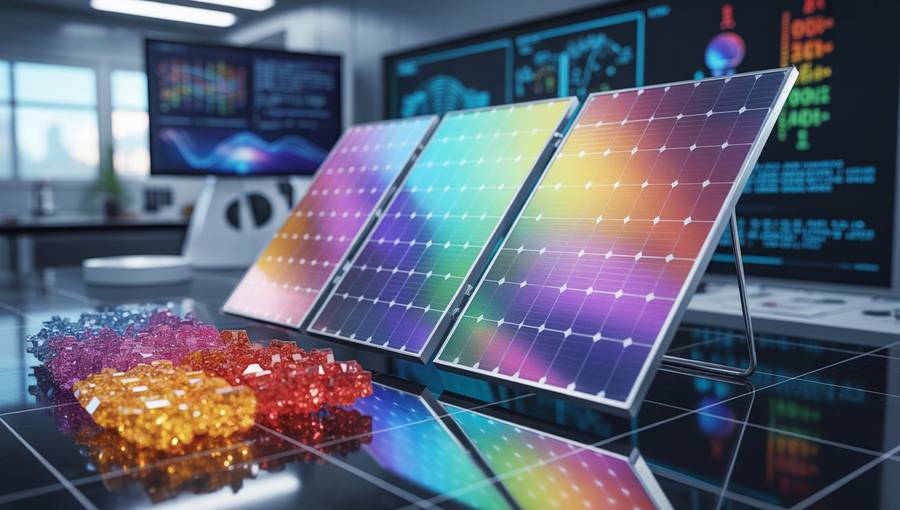
Researchers from Kyung Hee University and Hyundai Motor Group have pioneered an AI-driven method to create high-efficiency, full-color semitransparent perovskite solar cells. By utilizing an inverse design strategy and multilayer coatings, the team successfully engineered solar modules that can display a wide range of vivid colors without the typical performance losses associated with color tuning. This breakthrough paves the way for aesthetically pleasing solar windows and vehicle glazing, transforming ordinary surfaces into efficient power generators while maintaining visual appeal and transparency.
The research introduces a sophisticated framework that integrates all-dielectric multilayer coatings—consisting of alternating layers of zinc sulfide (ZnS) and magnesium fluoride (MgF₂)—directly into perovskite photovoltaics. Unlike traditional color-tuning techniques that often rely on metallic or absorptive films which can degrade performance, this approach utilizes transparent interference coatings. These coatings are designed through a digital optimization loop, where each layer sequence is treated as a binary string and analyzed by a factorization machine-based surrogate model.
To achieve precise visual results, the optimization process was formulated as a quadratic unconstrained binary optimization (QUBO) problem. This allowed the researchers to identify the exact ZnS/MgF₂ configurations required to meet specific color coordinates and average visible transmittance (AVT) targets. The system successfully produced six primary hues—red, green, blue, cyan, magenta, and yellow—across perovskite absorber thicknesses ranging from 65 nm to 165 nm.
The performance gains observed during testing were significant. A representative cyan-colored device with a 110 nm-thick absorber achieved a 20.9% increase in power conversion efficiency (PCE) compared to an uncoated device. When tested on flexible PET substrates, the coating reached a peak transmittance of 14.6% and a 10.4% efficiency gain, all while maintaining mechanical flexibility and optical clarity. These coatings can be applied via thermal evaporation or through a lamination-based assembly, which prevents potential damage to the solar cell from thermal or plasma exposure during manufacturing.
This AI-guided framework is highly versatile, as it depends on measured optical constants rather than empirical tuning. This makes it easily adaptable to other thin-film technologies, including organic, CIGS, or tandem solar cells. Future refinements using higher-bit digital encoding and simulated annealing are expected to further enhance color purity and chromaticity control.
By resolving the traditional trade-off between aesthetics and energy output, this technology transforms the naturally reddish-brown tint of semitransparent perovskites into a palette of user-selectable colors. This innovation opens new possibilities for architectural and automotive integration, allowing windows, building façades, and wearable devices to generate clean energy while blending seamlessly into their environments.